Every mesh box promises to cover 5,500 or 6,600 square feet. Almost none of them will do it in your house – those numbers come from open space, and your walls, floors, and kitchen appliances have not read the packaging. For a 2,000 to 3,000 sq ft home, the right question is not which kit claims the biggest number, but how many nodes you need and how they talk to each other.


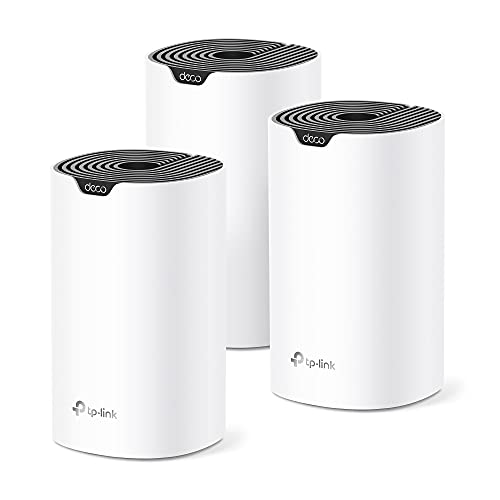


A home in this size range is the sweet spot for mesh: too big for one router, not big enough to need a rack of gear. What matters is node count for your layout, whether the kit supports a wired backhaul, and how much Wi-Fi speed the house genuinely uses. One plain note before we start: TP-Link’s Deco line so thoroughly dominates sales in this category that the best-selling options are all Deco. So this is really a comparison of which Deco suits which home – from a two-node budget kit to a Wi-Fi 7 set with multi-gig ports.
| Product | Standout feature | Price tier | Link |
|---|---|---|---|
| Deco X55 (3-pack) | AX3000, 3 Gigabit ports per unit, 150 devices | Mid-range | |
| Deco 7 BE25 (3-pack) | Wi-Fi 7 with MLO, two 2.5G ports per unit | Premium | |
| Deco S4 (3-pack) | AC1900, three nodes at the lowest price, works with Alexa | Budget | |
| Deco X20 (3-pack) | AX1800 Wi-Fi 6, 6 Ethernet ports in total, wired backhaul | Mid-range | |
| Deco X15 (2-pack) | Two nodes, AX1500 Wi-Fi 6, lowest-cost entry | Budget | |
How to choose a mesh system for a 2,000-3,000 sq ft home
Two nodes or three
This is the decision that matters most, and the coverage numbers on the box will not answer it. A two-node kit like the Deco X15 works well in an open-plan single story, or a home where the two floors stack neatly and the nodes can sit above one another. Three nodes earn their place when the layout fights you: a long narrow house, thick masonry or brick internal walls, plaster with metal lath, a basement, or a detached garage or office at the far end.
Note that most kits in this category ship as three-packs, including four of the five here. That is not because your home needs 6,500 sq ft of coverage; it is because a third node is cheap insurance against a dead corner. If your home is open and rectangular, two nodes may genuinely be enough, and the X15 two-pack is the real kit for that.
Why the coverage numbers are optimistic
A rating of 5,500 or 6,600 sq ft describes near-ideal conditions, and every listing here notes that performance varies by conditions. Wi-Fi is absorbed and reflected by ordinary building materials – brick, concrete, tile, foil-backed insulation, mirrors, and the metal box that is your fridge. A better rule of thumb: expect a node to cover the rooms on its own floor within about two walls of itself, and plan placement around that. In practice, a kit rated for 5,500 to 6,600 sq ft is about right for a real 2,000 to 3,000 sq ft home.
Wired backhaul is the upgrade nobody talks about
In a plain wireless mesh, the nodes talk to each other over the same Wi-Fi they serve to your devices, which costs throughput at every hop. Run an Ethernet cable between nodes and that traffic moves off the air entirely – the nodes stop competing with your laptop, and the far end of the house often improves more than any spec upgrade would deliver. Every kit here supports Ethernet backhaul, so if a cable already runs to the far room, or you can pull one, use it. The Deco 7 BE25 takes this furthest with two 2.5 Gbps ports per unit, and TP-Link notes that backhaul needs at least two units.
How much Wi-Fi speed you actually need
Be clear about the internet plan behind the router. If the connection delivers a few hundred megabits, an AC1900 kit like the Deco S4 or an AX1500 kit like the X15 will saturate it easily, and the money is better spent on node placement than a faster radio. Wi-Fi 6 kits earn their keep in busy homes because they handle many devices at once far better than Wi-Fi 5, not because one device gets faster. Wi-Fi 7 on the Deco 7 BE25 matters with a multi-gigabit plan or Wi-Fi 7 devices; otherwise it is buying ahead.
Ports, devices, and the small print
Count the Ethernet ports you need. The X15 and S4 have two per unit, the X55 three, and the Deco 7 BE25 two 2.5 Gbps ports. One port on the main unit goes to your modem, leaving fewer than the box number for actual devices. On capacity, the S4, X20, X55, and BE25 are rated around 150 devices and the X15 around 120 – figures that sound large until a home counts its bulbs, plugs, cameras, and speakers.
TP-Link Deco X55 – the best seller, and the sensible middle
This is the joint best seller in the group and the one that lands closest to what a 2,000 to 3,000 sq ft home actually needs. AX3000 means 2402 Mbps on 5 GHz and 574 Mbps on 2.4 GHz – comfortably more than most home internet plans deliver, with headroom for local transfers. Three nodes cover a rated 6,500 sq ft and up to 150 devices, and each unit carries three Gigabit Ethernet ports – one more per node than most of the range, and useful where a node sits near a TV, console, and streaming box. Ethernet backhaul is supported, and any unit can be the router.
It is Wi-Fi 6 rather than Wi-Fi 7, which for this size of home on a typical plan is the right call rather than a compromise. The mid-range price buys the faster radio and the extra port per node.
- Pros: Joint best seller here; AX3000 gives real headroom over typical home plans; three Gigabit ports per unit, the most of the Wi-Fi 6 kits; supports wired Ethernet backhaul; three nodes rated to 6,500 sq ft and 150 devices; any node can act as the router.
- Cons: Mid-range price; Wi-Fi 6 rather than Wi-Fi 7; Gigabit ports only, so a multi-gig plan would be capped; three nodes may be one more than an open-plan home needs.
Best for: Most homes in this size range – a busy household with plenty of devices and a normal broadband plan.
TP-Link Deco 7 BE25 – Wi-Fi 7 and multi-gig ports
The other joint best seller, and the most capable kit here. BE5000 dual-band Wi-Fi 7 delivers up to 4324 Mbps on 5 GHz and 688 Mbps on 2.4 GHz across 240 MHz channels, with three nodes rated for 6,600 sq ft and over 150 devices. The two features that matter most are less obvious than the headline speed. Two 2.5 Gbps ports per unit mean the wired side is not the bottleneck – for a multi-gigabit internet plan, or a wired backhaul that needs to carry more than a Gigabit, this is the only kit here that keeps up. And MLO, or Multi-Link Operation, lets a Wi-Fi 7 device use more than one band at once, which helps stability more than raw speed.
It also brings VPN support, AI-Roaming, and HomeShield. The real caveat: it is dual-band, not tri-band, so wireless backhaul still shares the air with your devices – the 2.5G ports answer that, but only if you can run a cable. On a few-hundred-megabit plan with no Wi-Fi 7 devices, most of this sits idle.
- Pros: Wi-Fi 7 with MLO and 4K-QAM; fastest radio here at up to 4324 Mbps on 5 GHz; two 2.5 Gbps ports per unit for multi-gig plans and fast wired backhaul; three nodes rated to 6,600 sq ft and 150+ devices; VPN, AI-Roaming, and HomeShield included; expandable with more Deco units.
- Cons: Premium price; dual-band, so wireless backhaul still shares the air; Wi-Fi 7 gains need Wi-Fi 7 client devices; overkill for a typical broadband plan.
Best for: Multi-gigabit internet plans, homes that can run Ethernet between nodes, and anyone buying for the next several years.
TP-Link Deco S4 – three nodes for the least money
Three nodes at the budget tier is a strong offer, because node count fixes dead zones more reliably than radio speed does. The S4 is AC1900 Wi-Fi 5, covers a rated 5,500 sq ft across its three units, gives two Gigabit ports per node – six across the kit – and supports wired Ethernet backhaul like the rest of the range. Setup runs through the same Deco app, roaming is seamless on one network name, and it works with Alexa.
Wi-Fi 5 is the real limitation, and it shows in a crowded house rather than on a speed test – congestion sets in when dozens of things talk at once. For a couple of laptops, some phones, and a TV, the S4 covers a large home for the price of one mid-range router.
- Pros: Three nodes at the lowest per-node price here; rated 5,500 sq ft; two Gigabit ports per unit, six in total; wired Ethernet backhaul supported; seamless roaming on one network name; Alexa support; any unit can be the router.
- Cons: Wi-Fi 5, so congestion handling lags the Wi-Fi 6 kits; AC1900 caps throughput on faster plans; fewer ports per node than the X55; older platform.
Best for: Covering an awkward large layout cheaply, in a home without a huge device count.
TP-Link Deco X20 – Wi-Fi 6 without the premium
The X20 is the bridge between the S4 and the X55: AX1800 Wi-Fi 6 across three nodes, rated for 5,800 sq ft and 150 devices, with six Ethernet ports across the kit and wired backhaul support. The reason to step up from the S4 is not the peak number – it is that Wi-Fi 6 schedules many devices far more efficiently, which is what a house full of phones, tablets, doorbells, plugs, and speakers actually stresses.
Against the X55, the X20 gives up radio headroom and one Ethernet port per node. On a moderate plan, with no node needing three wired devices, that is a fair trade for a lower price.
- Pros: Wi-Fi 6 device handling at a mid-range price; three nodes rated to 5,800 sq ft and 150 devices; six Ethernet ports in total; supports wired backhaul; same Deco app and seamless roaming; a clear step up from Wi-Fi 5 in busy homes.
- Cons: AX1800 has less headroom than the X55’s AX3000; two ports per node rather than three; Gigabit only; three nodes may exceed what an open plan needs.
Best for: Device-heavy homes on a normal broadband plan that want Wi-Fi 6 without paying for AX3000.
TP-Link Deco X15 – the genuine two-node kit
If you want two nodes rather than three, this is the kit built that way. Two units, AX1500 Wi-Fi 6 at 1201 Mbps on 5 GHz and 300 Mbps on 2.4 GHz, a rated 3,900 sq ft, up to 120 devices, and two Gigabit ports on each unit – four across the kit – with Ethernet backhaul supported. It is the lowest-priced option here and the only one that does not put a third node on your shelf.
The fit is specific. In an open single-story home, or a two-story where one node sits directly above the other, two well-placed nodes cover this size properly and a third would be idle. In a long or heavily walled house, the third node is what fixes the far bedroom, and a three-pack serves better. AX1500 is the slowest radio here, though ample for a typical household.
- Pros: A true two-node kit, right-sized for open layouts; lowest price here; Wi-Fi 6 device handling; two Gigabit ports per unit; wired Ethernet backhaul supported; less clutter and one fewer power outlet used; expandable with more Deco units later.
- Cons: AX1500 is the slowest radio in the group; rated 3,900 sq ft, the lowest here; 120 devices is the smallest ceiling; two nodes will struggle in a long or masonry-walled home.
Best for: Open-plan or neatly stacked homes at the smaller end of this range, where two nodes are genuinely enough.
The verdict
Best Overall – Deco X55. It shares the top sales position in this group and it is the best match for a 2,000 to 3,000 sq ft home. AX3000 leaves headroom over almost any home plan, three Gigabit ports per node is the most useful port count of the Wi-Fi 6 kits, and three nodes with wired backhaul support will cover an awkward layout without drama. It is the kit to buy if you would rather not think about this again.
Best Value – Deco X15 (2-pack). The cheapest way into Wi-Fi 6 mesh, and the only genuine two-node kit here. In an open or stacked home this size, two nodes do the job. If the layout is difficult, step up to the Deco S4 for three nodes instead.
Best Premium – Deco 7 BE25. Wi-Fi 7 with MLO and, more importantly, two 2.5 Gbps ports per unit. If the internet plan is multi-gigabit, or you can run Ethernet between nodes and want the backhaul to carry more than a Gigabit, nothing else here keeps up.
FAQ
Do I need two nodes or three for a 2,000-3,000 sq ft home?
It depends on shape, not just size. Open plan on one level, or two floors that stack, and two nodes usually cover it. Long, narrow, split-level, or heavy masonry walls, and the third node fixes the far corner. If unsure, three is the safer buy – a spare node can move to the garage.
Are the coverage figures on the box realistic?
They describe near-ideal conditions, and every listing here says performance varies by conditions. Real walls, floors, and appliances absorb signal. A kit rated for 5,500 to 6,600 sq ft is a sensible choice for a real 2,000 to 3,000 sq ft home, which is why those numbers look so generous.
What is wired backhaul and is it worth the trouble?
It means connecting the mesh nodes to each other with Ethernet cable instead of letting them talk over Wi-Fi. It is the single biggest improvement available to most mesh setups, because node-to-node traffic stops competing with your devices for airtime. Every kit here supports it. If a cable already runs to the far side of the house, use it.
Is Wi-Fi 7 worth paying for?
Only if something will use it. Wi-Fi 7 helps most with a multi-gigabit internet plan or Wi-Fi 7 client devices, and the Deco 7 BE25’s two 2.5 Gbps ports are arguably the more useful part of it. On a typical broadband plan with Wi-Fi 6 phones and laptops, an X55 or X20 delivers the same day-to-day experience for less.
This article may contain affiliate links; see our Affiliate Disclosure.