Ask two coffee people whether flat or conical burrs make better coffee and you will get a forty-minute argument and no answer. The plain version is shorter: the burr shape does change the cup, just far less than the burr size, the build, and whether the grinder can actually hold the setting you want.


What separates a good grinder from a frustrating one is consistency at the setting you actually brew at, and enough adjustment range to get there. Burr geometry is part of that story; motor speed, burr diameter, and how tightly the whole thing is built are the rest. The five below split three flat and two conical, from a compact budget machine to a full-metal 64mm flat-burr grinder, and they suit anyone from a once-a-morning drip drinker to someone dialling in shots.
| Product | Standout feature | Price tier | Link |
|---|---|---|---|
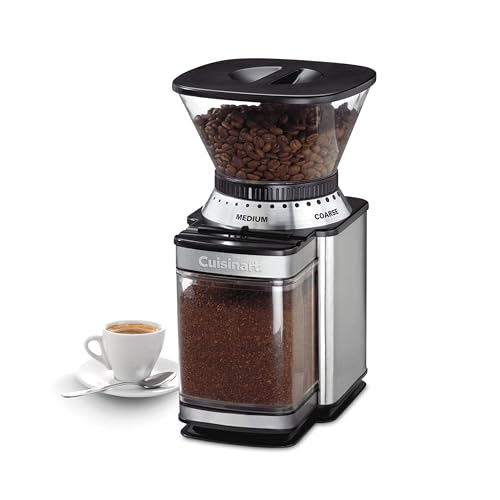
| Cuisinart DBM-8 (flat) | 18-position dial, grinds for 4-18 cups, one-touch timer | Mid-range | |
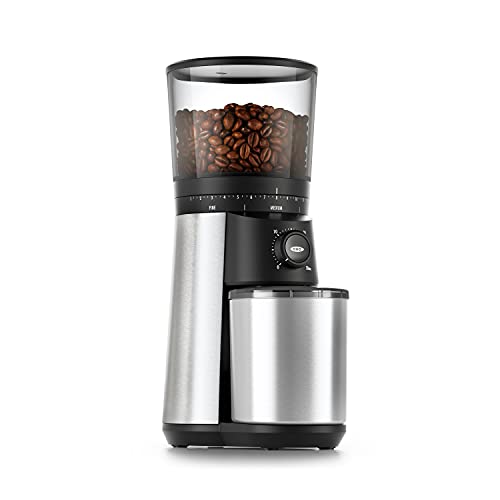
| OXO Brew Conical Burr | 15 settings plus micro-adjustments, 12 oz hopper, DC motor | Premium | |
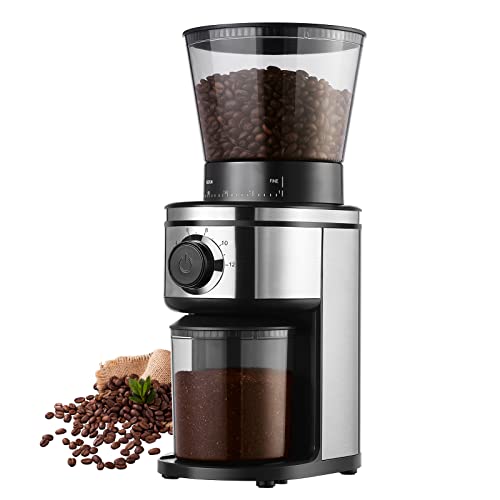
| SHARDOR 32-setting (flat) | 32 grind sizes, 40-second timer, compact footprint | Budget | |
| Ollygrin (conical) | 40mm burrs, gear-reduction motor, safety clutch | Mid-range | |
| MOKKOM 64mm (flat) | 64mm flat burrs, 100 settings, all-metal body, plasma anti-static | Premium | |
How to choose between flat and conical burrs
What the two shapes actually do
Conical burrs are a cone spinning inside a ring. Beans fall in, gravity helps pull them through a narrowing gap, and the grounds drop out the bottom. Because gravity does part of the work, conical burrs can run slower, generate less heat, and they clear themselves well when the machine stops.
Flat burrs are two rings facing each other. Coffee is pushed outward between them and every particle takes a similar path to the exit. That path uniformity is the flat burr’s real argument: it tends to produce a narrower spread of particle sizes at a given setting. The trade-offs are that flat burrs generally need more motor speed, retain a little more coffee inside the chamber between doses, and cost more to make well.
What that means in the cup
The widely held view among people who brew a lot of coffee is that flat burrs lean toward clarity and a defined, separated flavor, while conical burrs lean toward body and a rounder, sweeter cup. That is a tendency, not a law, and it is a smaller difference than most marketing implies. Two things matter more for the average kitchen: burr diameter, because bigger burrs cut more cleanly per rotation, and grind adjustment, because a grinder that cannot reach your target setting will never taste right regardless of geometry. A 64mm flat burr and a 40mm conical are not really competing on shape – they are competing on class.
Stepped settings and the espresso question
This is where plain advice matters. Espresso demands a very fine grind and, more importantly, the ability to move in tiny increments – the difference between a good shot and a bad one can be a fraction of a setting. Grinders with a modest number of stepped positions, like the 18-position Cuisinart or the 15-step OXO, are built primarily for drip, pour-over, French press, and cold brew. They will produce a fine grind, and both list espresso in their range, but they give you only a handful of choices down at that end, which makes dialling in a shot a coarse-grained exercise.
If espresso is the main event, look at the machines with a high setting count and a real adjustment mechanism: the MOKKOM offers 100 settings on 64mm flat burrs, and the SHARDOR gives 32 steps at a budget price. If espresso is an occasional curiosity and drip or press is daily life, the setting count matters far less than convenience.
Static, retention, and mess
Fine grounds hold a static charge and stick to everything. Manufacturers attack this in different ways: stainless steel catch cups reduce cling compared to plastic, and the MOKKOM includes a plasma generator at the exit chute to neutralize the charge outright. Retention – coffee left inside the machine – matters if you switch beans often, since yesterday’s grounds join today’s cup. Removable upper burrs, which all five have, are the practical fix.
Capacity and the shape of your morning
A 12 oz hopper full of beans is convenient if you brew the same coffee every day and hate refilling. It is a liability if you buy small bags of different beans, since beans sitting in a clear hopper go stale under light – which is exactly why the OXO tints its hopper against UV. Single-dosing, where you weigh in only the beans for the brew you are making, is the alternative, and the MOKKOM ships with a dedicated single-dose hopper alongside its large one.
Cuisinart DBM-8 – the best seller, and a genuine flat burr
This is the strongest seller in the group by a comfortable margin, and it is a flat burr machine, which quietly undercuts the idea that conical is the default for home kitchens. The design is refreshingly plain: an 18-position slide dial from ultra-fine to extra-coarse, a cup-size selector from 4 to 18 cups, a one-touch bar, and an internal timer that shuts the motor off when the cycle finishes. The 8 oz hopper and the grind chamber both lift out for cleaning, and a scoop and brush come in the box.
Set expectations correctly and it is very hard to beat. For drip, pour-over, French press, and cold brew it does exactly what is asked, day after day, with almost nothing to learn. What it is not is an espresso instrument: 18 stepped positions do not give the fine control a shot needs, and the settings are chosen for brewed coffee volumes rather than single doses.
- Pros: Flat burrs at a mid-range price; genuinely simple one-touch operation; 18 positions cover ultra-fine to extra-coarse; cup-size selector grinds the right amount for 4-18 cups; removable hopper and chamber; auto shut-off timer; scoop and cleaning brush included.
- Cons: Stepped settings are too coarse for dialling in espresso; volume-based dosing rather than weight; plastic chamber attracts static; the hopper leaves beans exposed to light.
Best for: Daily drip, pour-over, and French press drinkers who want fresh grinding without a learning curve.
OXO Brew Conical Burr – the well-mannered conical
The OXO is the conical case made carefully. Stainless steel conical burrs run on a DC motor chosen to grind without overheating, which is the classic conical advantage put to use. It offers 15 settings plus micro-adjustments, so there is more resolution here than the step count suggests. The considered details are what stand out: a UV-blocking tint on the 12 oz hopper to protect beans in a sunny kitchen, a trap door so beans do not spill when the hopper comes off, a stainless container that fights static, and one-touch start that remembers the last setting.
It sits at the premium tier for a grinder aimed at brewed coffee, and that is the fair criticism. The micro-adjustments help, but this is still a machine built around drip and press rather than shot-by-shot espresso work.
- Pros: Stainless conical burrs with a heat-conscious DC motor; 15 settings plus micro-adjustments for finer control than the number implies; UV-tinted 12 oz hopper protects beans; trap door avoids spills; static-reducing stainless container; remembers your setting.
- Cons: Premium price for a brewed-coffee grinder; step count is low for espresso dialling; large hopper suits one house bean rather than rotating small bags; larger footprint.
Best for: Households that brew the same beans daily and want a tidy, reliable conical grinder with thoughtful details.
SHARDOR 32-setting – flat burrs on a budget
Thirty-two grind sizes at the budget tier is a lot of adjustment for the money, and they sit on metal flat burrs rather than a blade or a token burr set. The 40-second adjustable electronic timer is the right control for a grinder like this: pick a time, press once, get the same dose tomorrow. A chamber cleaning button and removable burr, hopper, and chamber keep maintenance quick, and the body is deliberately small for tight counters.
SHARDOR is candid about the limit, which is worth respecting: the motor has a built-in safety program capping continuous grinding at 120 seconds before a cooldown, and the maker advises grinding in smaller batches. That is a compact grinder being clear about its motor, not a defect – but anyone grinding for a crowd should note it.
- Pros: Metal flat burrs at the lowest price here; 32 settings give real range from espresso-fine to French press; repeatable 40-second digital timer; removable burr, hopper, and chamber; cleaning button and brush; small footprint.
- Cons: Motor limited to 120 seconds of continuous grinding before cooldown; not built for large back-to-back batches; smaller burrs than the premium flat machines; no micro-adjustment between steps.
Best for: Anyone who wants flat burrs and wide adjustment on a small counter and a small budget.
Ollygrin – the conical built to survive a stone
Two engineering choices make this one interesting. First, a gear-reduction motor deliberately slows the grind, which is the textbook way to keep friction heat away from the beans and let 40mm stainless conical burrs work at their best. Second, a friction clutch protects the grinding gear if a small stone comes through with the beans – a real failure mode that ends cheaper grinders – backed by overheating protection for the motor. Around that sits 30 grind settings, a 2-12 cup selector, a 10 oz auto-locking hopper, and a single rotary control.
It is a mid-range machine and it behaves like one. The 30 settings are stepped with no micro-adjustment, and the cup-based dosing is a volume estimate rather than a weight. For brewed coffee across a range of methods, the durability features are a better use of the money than a bigger number on the box.
- Pros: 40mm stainless conical burrs; gear-reduction motor runs slow and cool; friction clutch guards against stones in the beans; overheating protection; 30 settings from espresso-fine to French press; 10 oz auto-locking hopper; lift-off upper burr for cleaning.
- Cons: Stepped settings with no micro-adjustment; dosing by cups rather than weight; large hopper exposes beans to light; still short of espresso-grade fine control.
Best for: Multi-method brewers who want a conical grinder with sensible protection built in for the long haul.
MOKKOM 64mm – what a flat burr looks like when it is serious
This is the machine that makes the flat-versus-conical debate concrete. The burrs are 64mm stainless flats – a size associated with cafe equipment, not kitchen appliances – and there are 100 grind settings to move across, which is the resolution espresso actually requires. The body is industrial-grade stainless with an aluminum alloy chamber base and a 7mm brass adjustment ring, and that matters: burr alignment holds only if the structure around it is rigid. A plasma generator in the exit chute kills static so grounds fall where they should, and an LED timer works to 0.1-second accuracy for single, double, top-up, and continuous doses. Two hoppers ship in the box – a 350g large one and a silicone single-dose bellows.
It is the most expensive option here and asks the most of its owner. A 100-step adjustment only helps someone willing to use it; for a drip drinker, this is a lot of grinder to own.
- Pros: 64mm flat burrs, far larger than the rest of this group; 100 settings give genuine espresso resolution; all-metal body with brass adjustment ring for rigidity; plasma anti-static at the chute; 0.1-second timer with dose presets; large and single-dose hoppers both included; removable upper burr and grounds press.
- Cons: Premium price; more complexity than a drip-only drinker needs; flat burrs retain more coffee than conicals between doses; larger and heavier on the counter.
Best for: Espresso at home, single-dosing, and anyone who wants cafe-scale flat burrs in a kitchen.
The verdict
Best Overall – Cuisinart DBM-8. It outsells everything else here for good reason. It is a flat burr grinder at a mid-range price that does drip, pour-over, and press without asking anything of you: one dial, one button, done. It is the right answer for most kitchens, and the fact that it happens to be flat rather than conical tells you how little the shape matters at this end.
Best Value – SHARDOR 32-setting. Budget tier, metal flat burrs, 32 settings, and a repeatable timer. The 120-second grinding cap is the real cost of the size and price, and it will not bother anyone grinding a pot at a time.
Best Premium – MOKKOM 64mm. Cafe-size flat burrs, a rigid metal body to keep them aligned, and 100 settings to move between. If espresso is the goal, this is the only machine in the group with the resolution to dial one in properly.
On the title question: if you want a conical for its cooler, gentler grind and rounder cup, the OXO is the well-built choice and the Ollygrin is the durable one. But the flat burr grinders here are not the compromise the debate implies – one of them is the best seller in the group, and another is the most capable machine on the list.
FAQ
Do flat burrs really make better espresso than conical?
Not by shape alone. Plenty of excellent espresso grinders use conical burrs, and plenty use flats. Flat burrs tend toward a narrower particle spread, which many people associate with clarity in the cup. But burr diameter, build rigidity, and fine adjustment decide far more. A 64mm flat with 100 settings beats a 40mm conical with 30 steps for espresso because of size and resolution, not because it is flat.
Can I use an 18-position or 15-setting grinder for espresso?
You can grind fine enough to attempt it, but you will not have the control to dial in a shot properly. Espresso often needs adjustment finer than a whole step on these machines. They are built for drip, pour-over, press, and cold brew, and they are good at it.
Why do grounds fly everywhere and stick to the container?
Static. Fine grinding builds a charge, and it is worst with dry, light-roasted beans in low humidity. A stainless catch cup helps, as on the OXO and MOKKOM. Some grinders add active anti-static systems – MOKKOM’s plasma generator at the chute is the most direct approach here. A common trick is adding a single drop of water to the beans before grinding.
Does a big hopper matter?
It depends how you buy coffee. One bean every day, and a large hopper saves refilling. Rotating through small bags, and beans sit going stale under light instead. That is why the OXO tints its hopper against UV and the MOKKOM ships a single-dose hopper too.
This article may contain affiliate links; see our Affiliate Disclosure.