The best-selling router here does not come with a battery. It says so quietly, in two words at the end of the name: tool only. Add the battery and charger and it is not the price you thought. That is the first of several things this category would rather you worked out later.




Almost everything here is a palm router: a one-handed tool with a quarter-inch collet, brilliant at edges and roundovers and hopeless at anything needing a big bit or a plunge cut. Two are full-size, and exactly one can plunge. If joinery is why you are reading, that narrows things immediately.
At a glance
| Router | Standout feature | Price tier | Link |
|---|---|---|---|
| AVID POWER 630W | Cheapest here; bits and two guides included | Budget | |
| TEENO | Six speeds and 15 carbide bits | Budget | |
| TwoWin | Best-selling palm router here; 15 bits in a case | Budget | |
| AVID POWER 6.5 Amp | The only one here with a second collet size | Budget | |
| SKIL 10 Amp | A full-size 2 HP motor, fixed base | Mid-range | |
| BOSCH Colt | Macro and micro depth; publishes its bit capacity | Mid-range | |
| SKIL 14 Amp Combo | The only plunge base here; LCD speed guide | Premium | |
| DEWALT 20V Max XR | Cordless and brushless; battery not included | Premium | |
How to choose a router
Palm router or full size, and it decides what you can build
A palm router is a one-handed trimmer with a quarter-inch collet and around one horsepower: right for roundovers, chamfers, flush trimming and small template work, and a pleasure to use. It is wrong for a large panel bit or a deep mortise, lacking both the mass and the shank size. SKIL’s 2 and 2.5 horsepower machines are the full-size ones here. Everything else, Bosch and DEWALT included, is a palm router doing palm router jobs.
Only one router here can plunge
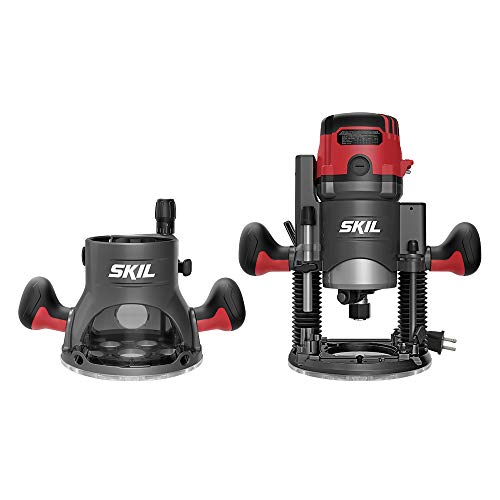
A fixed base sets the bit at one depth and you slide the router in from an edge. A plunge base lets you lower a spinning bit into the middle of a board and lift it out again, which is what stopped dados, mortises and inlay work require. That is joinery. SKIL’s 14 amp combo is the only machine on this page that ships a plunge base, and it comes with the fixed base as well. If your plan involves starting a cut anywhere other than an edge, that is the pick and the rest are not in the running.
Collet size is the ceiling on what you can fit
Every palm router here takes quarter-inch shanks, and AVID POWER’s 6.5 amp model is the only one publishing a second size, shipping both 3/8 and 1/4 inch collets. Big profile cutters mostly do not come in quarter-inch for good reason: a large cutter on a thin shank flexes. Take that as the real boundary of the page. These are small-bit routers.
Variable speed is a safety feature, not a convenience
Bosch publishes the range plainly at 16,000 to 35,000 RPM, and the reason to care is that big bits must run slower. A large diameter cutter at 35,000 RPM has enormous rim speed, and that is how bits break and workpieces get thrown. The cheap routers here quote a single top figure, around 30,000 to 35,000, and TEENO offers six speeds. SKIL’s combo goes furthest with an LCD that asks what bit and what material and suggests a speed, which for a beginner is genuinely the most useful thing on this page.
Soft start is what stops it leaping out of your hand
A router motor going from nothing to 30,000 RPM instantly twists hard against your wrist. Soft start ramps it up instead, and every serious tool here has it: DEWALT, Bosch and both SKILs all name it. Electronic feedback is the companion feature, holding the speed steady as the bit meets resistance rather than bogging down and burning the timber. The budget routers largely do not mention either, which tells you something about the first few seconds of every cut.
Read what is in the box, especially with cordless
DEWALT’s router is tool only: no battery, no charger. If you own the 20V system that is the correct, cheaper way to buy it. If not, the real price roughly doubles. At the other end the budget routers pile in accessories: TwoWin and TEENO each include 15 carbide bits in a case, AVID adds bits, an edge guide, a roller guide and a dust hood. Those bundles are real value when you own nothing.
AVID POWER 630W
The cheapest router here and a sensible first one. A 630 watt, 5.3 amp motor spins to 35,000 RPM, which is plenty for edge work in hardwood, and the fixed base holds a setting properly with a smooth depth adjustment. What lifts it above the price is what comes with it: a quarter-inch collet, five bits, and both a straight edge guide and a roller guide, which are the two accessories that turn a router from a thing that makes a groove into a thing that makes a groove where you wanted it. Rubber grip, light, corded.
Pros:
- Cheapest router here
- Straight edge guide and roller guide both included
- Five bits and a 1/4 inch collet in the box
- 35,000 RPM with smooth depth adjustment
Cons:
- No soft start mentioned; expect a kick on startup
- Single speed, so large bits are out
- 630 watts is the least power here
Best for: a first router for roundovers and edges, cheaply.
TEENO
More motor and more choice: a 6.5 amp, 1.25 horsepower pure copper motor with six variable speeds, which is the feature that actually matters because it lets you slow down for a larger cutter instead of hoping. The base is impact-resistant and transparent, so you can see the bit meeting the line rather than working blind, which is worth more than it sounds on a curve. Fifteen tungsten carbide bits and three guides come in the kit, in a heavy-duty polymer body with an ergonomic grip.
Pros:
- Six variable speeds at a budget price
- 1.25 HP from a pure copper motor
- Transparent base; you can see the cut
- Fifteen carbide bits and three guides included
Cons:
- No soft start or electronic feedback mentioned
- 1/4 inch collet only
- Sells modestly against the cheaper TwoWin
Best for: a budget router where you want to control the speed.
TwoWin
The best-selling palm router here, and the pitch is straightforward: 800 watts, 30,000 RPM, an aluminum and plastic body, a transparent base for a clear view of the cut, and a wooden index case holding fifteen tungsten carbide bits so you can start on the day it arrives. It handles edging, trimming, veining and grooving in wood, veneer and plastic sheet. There is no speed control and no soft start, which at 30,000 RPM you will feel in your wrist every time you pull the trigger.
Pros:
- The best-selling palm router here
- Fifteen carbide bits in a wooden index case
- Transparent base for a clear view of the cut
- 800 watts in an aluminum-bodied tool
Cons:
- No variable speed; one figure, take it or leave it
- No soft start mentioned
- 1/4 inch collet only
Best for: a complete kit for trimming and edging, for very little.
AVID POWER 6.5 Amp
The best-specified budget router here, and the only one on this page that ships two collets: 3/8 and 1/4 inch, which widens the bits you can actually fit. A 6.5 amp motor at 1.25 horsepower with variable speed, a rack-and-pinion depth adjustment that is genuinely more precise than a threaded ring, LED lights on the cut, and a quick locking system for changing depth or swapping the base. The body and base are aluminum, and a dust hood is included, which is rare at this price and the difference between seeing your line and not.
Pros:
- Ships both 3/8 and 1/4 inch collets; the only one here
- Rack-and-pinion depth adjustment for real precision
- Dust hood and LED lights included
- Aluminum body and base; five bits and two guides
Cons:
- No soft start mentioned
- The lowest seller among the budget routers
- Still a palm router; no plunge base
Best for: budget money with the precision features usually left out.
SKIL 10 Amp
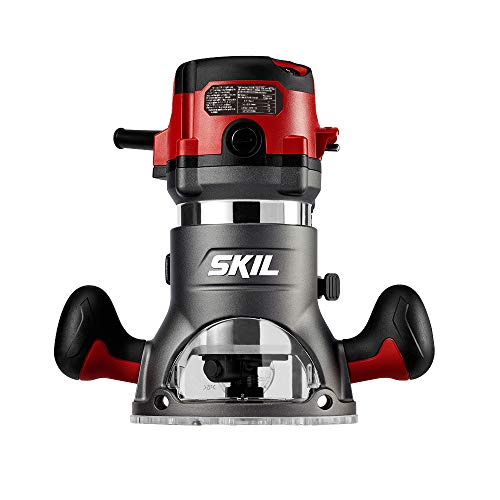
A full-size router, and the step up is real: 10 amps and 2 horsepower is roughly double what the palm routers manage, which means bigger bits, deeper passes and a motor that does not complain in hard maple. Speed control lets you match the bit and material, soft start keeps it from twisting out of your hands, and a die-cast motor housing with shaped handles gives you something to actually hold with two hands, which is how a router this size is meant to be used. A live tool indicator lights when it is connected to power.
Pros:
- 2 HP from a 10 amp motor; roughly double the palm routers
- Soft start and variable speed control
- Die-cast housing with proper two-handed grips
- Live tool indicator; genuinely useful safety detail
Cons:
- Fixed base only; it cannot plunge
- No bits or guides included
- Too big for delicate one-handed trimming
Best for: bigger bits and deeper cuts than a palm router will take.
BOSCH Colt
The palm router the others are copying. A 1 horsepower, 5.6 amp motor runs from 16,000 to 35,000 RPM with soft start and Constant Response circuitry holding the speed under load. The depth system does both macro and micro adjustment, which is the difference between roughly right and exactly right, with a quick clamp for changing it fast. Bosch is also the only brand here publishing a bit capacity, at up to 1 and 5/16 inches in the fixed base, and it includes a straight edge guide that works up to 3 and 5/8 inches from an edge. Rugged aluminum base, finger support pockets.
Pros:
- Publishes its speed range and its maximum bit diameter
- Soft start with Constant Response speed holding
- Macro and micro depth adjustment with a quick clamp
- Rugged aluminum base with finger support pockets
Cons:
- Costs double the budget palm routers
- No bits included
- 1 HP; still a palm router with a palm router’s limits
Best for: edge work done precisely, on a tool that will outlast the shop.
SKIL 14 Amp Combo
The only router here that can plunge, and the most powerful at 14 amps and 2.5 horsepower. Both bases are in the box, so it is a fixed-base router for edges and a plunge router for mortises, stopped dados and inlay, which is the difference between decorating a board and joining two. The LCD is the clever bit: tell it the bit type and the material and it suggests a speed, which is exactly the knowledge a beginner lacks and the thing that breaks bits. Electronic feedback holds the RPM under load, soft start keeps it civilized, and a live tool indicator warns you it is plugged in.
Pros:
- The only plunge base here, and the fixed base is included too
- 2.5 HP from 14 amps; the most powerful on this page
- LCD suggests a speed from the bit and material
- Electronic feedback, soft start and a live tool indicator
Cons:
- Among the most expensive here
- Big and heavy for delicate one-handed work
- No bits or guides included
Best for: joinery, which nothing else here can actually do.
DEWALT 20V Max XR
The best-selling router on this page and the one with the biggest asterisk: it is sold tool only, so no battery and no charger. Inside the 20V system that is the right way to buy it and the price is fair. Outside it, budget again. The tool itself is excellent: a brushless motor with soft start and full-time electronic feedback holding speed through the cut, a variable-speed dial, a depth adjustment ring for quick height changes, dual LEDs on the work and an electronic brake that stops the bit fast when you release it. No cord to drag across the workpiece.
Pros:
- The best-selling router here; brushless and cordless
- Soft start with full-time electronic feedback
- Electronic brake stops the bit quickly after shutoff
- Dual LEDs and a quick depth adjustment ring
Cons:
- Tool only: no battery and no charger included
- Costs roughly double once you buy the battery
- Palm-router power; no plunge base
Best for: anyone already invested in the 20V battery system.
The verdict
Best overall: BOSCH Colt. It is the palm router the budget tools are imitating, and the differences are the ones you feel: soft start so it does not twist out of your hand, Constant Response holding the speed when the bit bites, a published 16,000 to 35,000 RPM range so you can slow down for a bigger cutter, and macro plus micro depth adjustment so you can set it exactly rather than nearly. Bosch is also the only brand here that will tell you the biggest bit it takes.
Best value: AVID POWER 630W. The cheapest router on this page, and it arrives with the things you would otherwise buy next: five bits, a straight edge guide and a roller guide. Thirty-five thousand RPM and a smooth depth adjustment cover roundovers and chamfers properly. There is no soft start and no speed control, so keep the bits small and expect a kick when you pull the trigger.
Best premium: SKIL 14 Amp Combo. The only machine here that can plunge, which means it is the only one that can cut a mortise or a stopped dado, which means it is the only one that does joinery rather than decoration. Both bases are included, it is the most powerful tool on the page at 2.5 horsepower, and the LCD that suggests a speed from the bit and material is the single most useful feature for anyone still learning what to set.
FAQ
Why is the DEWALT so cheap?
It is not: it is sold tool only, with no battery and no charger. If you already own 20V batteries that is exactly how you want to buy it. If you do not, add a battery and a charger and the real cost roughly doubles. Those two words at the end of the product name are the whole story.
Can a palm router do joinery?
Not really. Joinery needs plunge cuts, starting a spinning bit in the middle of a board for a mortise or a stopped dado, and only the SKIL 14 amp combo here ships a plunge base. Palm routers are fixed-base tools for edges, roundovers, chamfers and flush trimming, and they are excellent at that.
Does variable speed matter?
Yes, for safety as much as finish. Larger bits must run slower, because rim speed rises with diameter and that is how bits break. Bosch publishes 16,000 to 35,000 RPM; the cheapest routers give you one speed near the top. SKIL’s combo asks what bit and material you are using and suggests a number.
What does the collet size limit?
Which bits will physically fit. Everything here takes quarter-inch shanks, and AVID POWER’s 6.5 amp model is the only one shipping a second collet at 3/8 inch. Large profile cutters mostly come on bigger shanks for good reason, so take this page as small-bit routers and buy bits accordingly.
What is soft start actually for?
Stopping the tool twisting out of your hand. A router going from zero to 30,000 RPM instantly kicks hard, and soft start ramps it up over a moment instead. DEWALT, Bosch and both SKILs all have it; the budget routers mostly do not mention it, which you will notice on every startup.
This article may contain affiliate links; see our Affiliate Disclosure.