A neck strap swings your camera into doorframes and shouts “expensive gear here.” A wrist strap keeps a compact or mirrorless body ready in one hand, out of the way, and far less likely to hit the pavement when your grip slips.


A good wrist strap comes down to a secure connection, a comfortable loop, and the right attachment for your camera. This guide compares five popular options, from a minimalist quick-release design to a padded grip, so a mirrorless shooter, a street photographer, or someone who just wants cheap insurance for a point-and-shoot can find the right one.
| Wrist strap | Standout feature | Price tier | Link |
|---|---|---|---|
| Peak Design Cuff | Anchor Link quick release, low profile | Premium | |
| AQAREA Quick-Release | Woven paracord, versatile connectors | Mid-range | |
| SmallRig Leather | Vintage leather, mirrorless friendly | Budget | |
| Altura Photo Padded | Padded grip with a secure tether | Mid-range | |
| VKO Rope Strap | Ultralight, lowest price | Budget | |
How to choose a camera wrist strap
Check the attachment your camera uses
Most mirrorless and compact cameras have small round strap lugs, and cord-and-loop straps thread through those directly, which is why so many designs here mention round-hole compatibility. Larger bodies often add a quarter-inch tripod socket on the base, which is where a plate-mounted grip strap like the Altura anchors. Peak Design uses its own Anchor Link tabs that clip into the lugs and detach in a second. Before you buy, look at your camera’s lugs and base and match the strap to what you actually have, since the fanciest strap is useless if it will not connect.
Quick release versus fixed
A quick-release system lets you pop the strap off to drop the camera on a tripod or into a bag, then reattach in seconds. Peak Design’s Anchor Link and the beaded quick-connectors on paracord straps both do this well, and it is a genuine convenience if you switch between handheld and tripod work. Fixed straps are simpler and have one fewer part to fail, which some photographers prefer for peace of mind. Decide how often you will detach the strap, because that is what makes quick release worth the small extra cost and bulk.
Comfort, security, and load rating
A wrist strap should cinch snug so the camera cannot slide off, ideally with an adjuster you can tighten one-handed. Materials change the feel: woven paracord is tough and grippy, leather softens and looks smart, and padded designs cushion a heavier body during long shoots. Pay attention to the stated load capacity, which ranges from a couple of dozen pounds on light cord straps to well over a hundred on reinforced systems. Any of these easily hold a mirrorless camera, but a bigger margin is reassuring if you shoot with a chunky lens.
Loop or grip: two different ideas
These straps split into two philosophies, and picking the wrong one is the usual regret. A loop strap is a cord or band that connects to a strap lug and hangs the camera from your wrist. It is minimal, weighs almost nothing, and lets the camera dangle when you are not shooting, which is ideal for a light mirrorless body and street work. A grip strap threads over the back of your hand and anchors to the tripod socket, holding your palm against the body so the camera is always aimed and your fingers rest on the shutter. It is more secure with a heavier camera and long lens, and far better for a day of continuous shooting, at the cost of bulk and the tripod socket. If your camera is small and you shoot in bursts between walking, take the loop; if it is heavy and you shoot constantly, take the grip.
The tripod socket question
Anything that mounts to the base of your camera occupies the quarter-inch thread, and that thread is also how tripods, gimbals, and quick-release plates attach. If you never use a tripod this is a non-issue. If you do, you have three options: unscrew the strap each time, which gets old fast, choose a plate-mounted strap that includes a pass-through thread, or skip base-mounted designs altogether and use a lug-connected loop instead. This is worth deciding before you buy rather than after, because it quietly rules out an entire category for tripod users.
Peak Design Cuff
The Cuff is the strap to beat for a blend of security, convenience, and clean design. Its Anchor Link system clips into your camera’s lugs and releases in a snap, and each anchor is rated to hold well over a hundred pounds, so drop protection is never in question. You can leave it as an open loop to slide your hand through, then pull it snug, and it instantly tightens if the camera slips. When you are not shooting it wraps around your wrist like a bracelet, which is why it disappears into everyday carry. Slim hardware and a low-profile look round it out.
The Anchor Link system is the part worth thinking about, because it is a small commitment. The anchors are little tabs that stay attached to your camera’s lugs permanently, and any Peak Design strap clips onto them, so a wrist strap in the morning and a sling in the afternoon swap in seconds. That is genuinely useful if you own more than one of their straps, and it is mildly proprietary if you do not. The cinch behavior is the safety feature people notice: leave it open to slip your hand through, pull to snug it, and if the camera does slip the loop tightens rather than opening. It connects to the lugs, so your tripod socket stays free.
- Fast, secure Anchor Link quick release
- Very high load rating for confident drop protection
- Cinches snug and wears as a bracelet when idle
- Universally compatible across camera systems
- Highest price of the group
- Anchor tabs are a proprietary system to adopt
Best for: photographers who want the most secure, convenient strap and will use the quick release often.
AQAREA Quick-Release Wrist Strap
The AQAREA is the versatile middle ground, hand-woven from paracord and shipped with two connector options so it fits a wide range of mirrorless and DSLR bodies. You get a triangular ring for a more stable link and a circle ring for quicker changes, plus a small leather pad to protect the camera body. A stainless quick-release ring adjusts the tightness and lets you take the strap off when needed, and at well under two ounces it never weighs on the wrist. It holds up to around forty-five pounds, far more than any mirrorless kit needs.
The two connectors are the reason it fits such a long compatibility list, spanning rangefinders, Sony, Fujifilm, Canon, Nikon, Panasonic, and Olympus bodies with round strap holes. The triangular ring sits more stably against the body, while the circle ring is quicker to thread, and the small leather pad stops either from scuffing the camera, which is a thoughtful detail cheaper straps skip. Paracord has a particular feel: slightly textured and grippy rather than soft, which some photographers love and others find scratchy against bare skin in summer. At sixteen inches it is long enough to wrap comfortably, and it packs into a pocket.
- Tough woven paracord with a grippy feel
- Two connector types for broad camera compatibility
- Quick-release ring and adjustable tightness
- Very light with a body-protecting leather pad
- Paracord look is more utilitarian than elegant
- Fiddlier to set up than a clip-in system
Best for: mirrorless shooters who want a rugged, adjustable strap that fits almost any body.
SmallRig Vintage Leather Wrist Strap
The SmallRig leather strap is for the photographer who wants their gear to look as considered as their shots. Made from genuine leather with a microfiber lining, it is soft, breathable, and adds a warm vintage touch that suits retro-styled mirrorless cameras especially well. It attaches by a cord or a metal loop to fit most strap holes, weighs a mere thirty grams, and adjusts to any wrist with a microfiber stopper. Because leather is natural, each strap varies slightly in color, which is part of the charm rather than a flaw.
At ten inches it is shorter than the paracord options, which keeps the camera closer to the wrist rather than swinging, and the microfiber stopper cinches it to fit. Leather behaves differently from cord over time: it stiffens when new, softens with use, and picks up a patina, so it looks better after a year than it did in the box. The trade-off is care, since leather does not appreciate being soaked and benefits from an occasional conditioning. It attaches by cord or metal loop to most strap holes, so it suits retro-styled bodies and compacts especially well.
- Genuine leather with a comfortable microfiber lining
- Vintage look that pairs well with mirrorless bodies
- Very light and adjustable for any wrist
- Cord or metal loop fits most strap holes
- No fast quick-release mechanism
- Leather needs occasional care to stay supple
Best for: style-minded shooters who want a comfortable, good-looking strap for a compact camera.
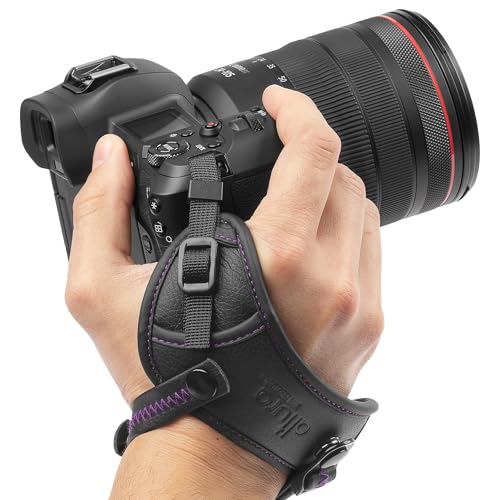
Altura Photo Padded Hand Strap
The Altura takes a grip-strap approach rather than a simple loop, and it is the most secure feel for heavier setups. A metal plate screws into the camera’s tripod socket for a rock-solid mount with no wobble, and a secure tether catches the camera even if your hand shifts, adding a second layer against drops. The padded PU leather wrist holder spreads the load and cushions long shoots, and the dual-grip design holds both hand and wrist so the camera stays poised for the next shot. It fits any body with a standard tripod screw mount.
This is the grip-strap philosophy done properly, and it changes how you shoot. Because your hand is held against the body, the camera stays pointed and your finger sits on the shutter, so you fire without regripping between frames. That is why event, wedding, and wildlife photographers gravitate to this style through hours of shooting, and the padding is what makes those hours bearable. The compatibility list runs across the major Canon, Sony, and Nikon lines and anything else with a standard thread. The real caveat is the tripod socket: this design lives there, so tripod users should plan around it.
- Plate-mounted for a solid, wobble-free connection
- Secure tether as backup drop protection
- Padded grip reduces fatigue on long shoots
- Keeps the camera ready for rapid shooting
- Occupies the tripod socket unless you add a pass-through plate
- Bulkier than a minimalist loop
Best for: event and travel shooters who want a padded, ready-to-fire grip on a larger camera.
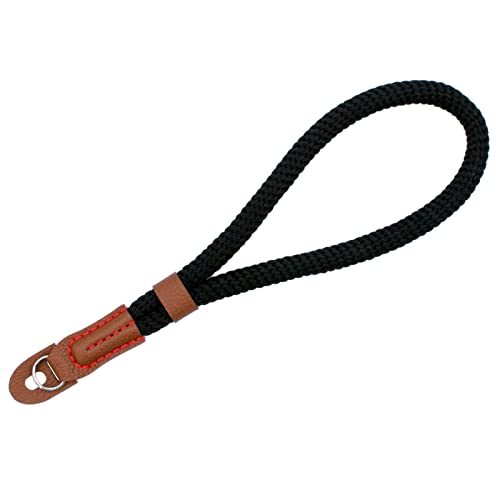
VKO Camera Wrist Strap
The VKO is the budget pick that proves a wrist strap does not need to cost much to do its job. Built from microfiber leather and nylon, it is comfortable and secure around the wrist, and at about half an ounce it is the lightest here, so a compact camera feels like it is wearing nothing. A microfiber stopper cinches it to any wrist size, and it is designed for mirrorless cameras with round connection holes. It is refreshingly simple: no plates, no clips, just a dependable loop for a few dollars.
There is a real argument for buying the cheap one. A wrist strap’s job is to stop a drop, and a well-made nylon cord with a twelve-millimeter diameter does that as surely as a costly system, provided you cinch it. What you forgo is convenience and polish: no quick release, no padding, and no fast swapping between cameras. For a compact or a light mirrorless body that lives in a jacket pocket, none of that is missed. The one thing to do before ordering is check the compatibility list, since it is designed around round connection holes and that is worth confirming against your camera.
- Lowest price of the group
- Extremely light and comfortable
- Microfiber stopper adjusts to any wrist
- Fits mirrorless cameras with round strap holes
- No quick release or padding
- Check the compatibility list before buying
Best for: compact and mirrorless owners who want cheap, reliable drop insurance in the lightest package.
Verdict
Best Overall: the Peak Design Cuff is the most complete strap here. Its snap-in Anchor Link release, very high load rating, and bracelet-when-idle design make it the one that feels secure and gets out of the way, which is exactly what a wrist strap should do.
Best Value: the AQAREA covers most mirrorless and DSLR bodies with two connectors and a quick-release ring for a mid-range price, while the VKO is the champion when you simply want the lightest, cheapest reliable loop.
Best Premium feel: the SmallRig leather strap looks and feels lovely on a compact camera, and the Altura is the pick for a padded, ready-to-fire grip on a heavier setup.
Frequently asked questions
Will these fit my mirrorless camera? Most mirrorless bodies have small round strap lugs, and the cord-and-loop straps here thread through them directly. Plate-mounted grips like the Altura use the tripod socket instead. Always check your camera’s lugs and base against the strap’s stated compatibility.
Is a wrist strap secure enough for an expensive camera? Yes, when cinched properly. These straps hold far more weight than a mirrorless kit weighs, and a snug adjuster keeps the camera from sliding off. For extra reassurance, choose a design with a secure tether or a very high load rating.
Wrist strap or neck strap? A wrist strap keeps a light camera ready in one hand and stays out of the way, ideal for street and travel shooting. A neck or sling strap suits heavier bodies you carry all day. Many photographers keep both and switch by outing.
What is a quick-release system and do I need one? It lets you detach the strap in a second to mount the camera on a tripod or stow it, then reattach just as fast. If you switch between handheld and tripod work often, it is a real convenience; if not, a simple fixed strap is perfectly fine.
Will a hand strap block my tripod mount? A plate-mounted grip strap uses the tripod socket, so yes unless it offers a pass-through thread. Loop straps that connect to the camera’s side lugs leave the socket completely free, which is the simpler answer if you use a tripod regularly.
Do the load ratings actually matter? Not for capacity, since even the lightest strap here holds far more than a mirrorless camera weighs. They matter as a rough proxy for how the strap is built. A higher rating usually signals better cord, stitching, and hardware, which is what survives years of daily use.
This article may contain affiliate links; see our Affiliate Disclosure.