Your frame rate is fine for twenty minutes, then the fans scream, the clock drops, and the game turns to slideshow. That is thermal throttling, and a cooling pad that moves real air is one of the cheapest ways to claw those frames back.



A cooling pad that genuinely lowers temperatures needs more than a row of glowing fans; it needs to push air where the laptop actually breathes. This guide compares five popular pads, from quiet multi-fan stands to high-pressure turbofan designs, so a casual player, a marathon gamer, or someone rescuing an older laptop can pick the right level of airflow.
| Cooling pad | Standout feature | Price tier | Link |
|---|---|---|---|
| Kootek 5-Fan | Quiet, adjustable, dual USB hub | Budget | |
| Havit HV-F2056 | Slim, light, USB powered | Budget | |
| llano V12 Turbofan | Large turbofan for rapid cooling | Premium | |
| ICE COOREL 8-Fan | Eight fans, wide-laptop support | Budget | |
| Razer Cooling Pad | Airtight chamber, smart fan curves | Premium | |
How to choose a laptop cooling pad
Airflow versus static pressure
Here is the detail marketing skips. A wall of small fans moves a lot of air across the underside of a laptop, but much of it spills out the sides. A single large turbofan, especially one sealed against the laptop with a foam gasket, builds static pressure and forces air up through the machine’s own intake vents, which is what actually reaches the hot components. That is why the high-pressure designs here tend to drop core temperatures more than a fan count alone would suggest. For light gaming, a quiet multi-fan stand is plenty; for a hot, powerful laptop that throttles, a turbofan or sealed-chamber pad is the plain answer.
Match it to your laptop and vents
Check two things: the size range the pad supports, and where your laptop pulls air in. Most pads cover a span of screen sizes, and the bigger turbofan units are built for large fifteen-to-nineteen-inch gaming machines. If your laptop draws air from a central intake on its base, a pad that concentrates airflow there will help most; if the fan sits off to one side, a wider multi-fan surface hedges your bets. Raised feet or stoppers that keep the laptop from sliding are worth having on any pad you actually game on.
Noise, power, and extras
Airflow and quiet are a trade-off, so look for adjustable fan speed to dial in the balance you want during a session. Note how the pad is powered: simple stands run off a USB port, while the strongest turbofans use their own power adapter to spin faster. Useful extras include a pass-through USB hub so you do not lose a port, a removable dust filter that protects the fans and your laptop’s intake, adjustable height for a better typing angle, and lighting if that matters to your setup.
Read temperature claims carefully
Cooling pads advertise dramatic numbers, and the figures deserve context rather than dismissal. A claim of a large drop within ninety seconds is usually measured from a laptop already heat-soaked at full load, where the first blast of air produces the biggest change, and it often combines processor and graphics readings. That is not misleading, but it is a best case, not what you will see across an evening. The realistic expectation is more modest: a simple fan stand trims a few degrees and mostly helps surface heat and lap comfort, while a sealed turbofan can meaningfully lower sustained core temperatures on a laptop that throttles. The real test of any pad is whether your clock speeds stop dropping, not what the marketing says.
Do the free things first
A pad works best alongside basic maintenance. A laptop clogged with dust is fighting its own intake, so clearing the vents does more than any accessory, and putting a laptop on a duvet or a carpet blocks the intake entirely. Ambient temperature sets the floor, since no pad can deliver air cooler than the room. A laptop’s own fan curve and power settings often have more headroom than an external fan does, so check whether the manufacturer’s software has a performance or cooling mode before concluding you need hardware.
Kootek 5-Fan Cooling Pad
The Kootek is the most popular pad here, and it is the sensible default for most laptops. Five fans, one large and four smaller, spread quiet airflow across the base, and two switches let you run one fan, four, or all five so you can trade cooling for silence. Six height settings make it a comfortable stand for gaming or working, a dual USB hub keeps your ports free, and front stoppers hold laptops from twelve to seventeen inches in place. It runs off USB, so there is no adapter to find. It will not match a turbofan on a scorching machine, but for the money it is an easy win.
The switchable fan groups are more useful than they first appear. Running only the large central fan gives you gentle airflow with almost no noise for browsing or writing, and flipping all five on for a gaming session is a single press, so you are not choosing between a quiet desk and a cool laptop once and for all. Six height settings mean it doubles as a proper ergonomic stand, lifting the screen toward eye level, which is a real benefit if this is also your work machine. The dual USB hub gives back the port the pad occupies, and note the supplied cable is USB-A, so a USB-C-only laptop needs an adapter.
- Five quiet fans with selectable fan groups
- Six adjustable height settings for comfort
- Dual USB hub keeps a port free
- Fits twelve to seventeen inch laptops, USB powered
- Multi-fan airflow trails a true turbofan on hot laptops
- USB power caps the top-end fan speed
Best for: most players who want quiet, adjustable, no-fuss cooling at a low price.
Havit HV-F2056 Slim Cooling Pad
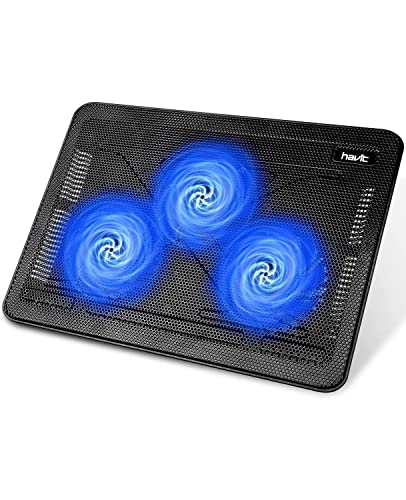
The Havit is the travel-friendly option, a slim, light three-fan pad that slides into a bag as easily as the laptop it cools. Its three ultra-quiet fans and metal mesh surface provide steady airflow and a stable platform, and two height settings give a gentle ergonomic tilt. It draws power over USB with an extra pass-through port and a switch, so setup is nothing more than plugging in. It is aimed at fifteen-to-seventeen-inch laptops, and while it is a modest cooler rather than a throttling-buster, its portability and near-silence make it a favorite for people who work and play on the move.
The metal mesh top is a big part of why this design has been a staple for so long: it is rigid, it does not sag under a heavy laptop, and it lets air pass rather than trapping it. Set expectations at the right level and it satisfies. This is a comfort-and-longevity pad rather than a performance part, keeping the chassis cooler on your lap and giving the internal fans easier air. If your laptop throttles hard in demanding games, look at the turbofans instead.
- Slim and light for easy travel
- Three ultra-quiet fans and a stable mesh surface
- Two height settings for a comfortable tilt
- USB powered with a pass-through port
- Modest cooling for demanding gaming
- Only two height positions
Best for: commuters and students who want quiet, portable cooling for lighter loads.
llano V12 Turbofan Cooling Pad
The llano V12 is where this list gets serious about temperatures. Instead of many small fans, it uses one large turbo booster fan paired with a foam seal, so it pressurizes air into the laptop’s intake rather than blowing it around the outside. The manufacturer cites a substantial temperature drop within the first minute-and-a-half on heavy loads, and a scroll wheel gives fine, instant control over airflow. A removable dust filter protects the fans, a three-port USB hub adds connectivity, and three tilt angles ease neck strain. It runs off its own thirty-six-watt adapter to feed that big fan, and it is built for large fifteen-to-nineteen-inch gaming laptops.
The dust filter is the feature to appreciate, and it solves a problem most people ignore. Blowing air at a laptop also blows dust at it, and a gaming machine’s intake steadily fills with hair and debris until it strangles itself, which is the real reason older laptops run hot. A high-density removable filter catches that before it enters, and it lifts out for cleaning, so the pad protects the machine rather than slowly clogging it. The trade-off is that this is a bigger, more involved device than a simple stand: it wants a wall socket, it is loud at full speed, and it is built for large chassis, so a thirteen-inch ultrabook is the wrong match.
- Large turbofan with a foam seal for pressurized airflow
- Scroll-wheel speed control for precise tuning
- Removable dust filter and three-port USB hub
- Powered adapter drives strong cooling on big laptops
- Larger and louder at full speed than fan stands
- Needs a power outlet, not just USB
Best for: gamers with a hot, powerful laptop that throttles and needs real airflow.
ICE COOREL 8-Fan Cooling Pad
The ICE COOREL splits the difference with eight fans and a feature set that punches above its price. Vents on the top and bottom of the case let you set different fan modes, an LCD shows the current fan speed, and touch buttons handle the RGB lighting and speed. Six height settings and a broad surface suit fifteen-to-seventeen-inch laptops, and a built-in phone stand and dual USB ports round it out. Capacitor-tuned fans keep it fairly quiet even wound up. It is a strong multi-fan value for players who want plenty of coverage and a bit of show without stepping up to a powered turbofan.
Eight fans is a headline number, so be straight about what it buys. More fans spread airflow across a wider area, which suits a big seventeen-inch chassis where heat is not concentrated in one spot. What it does not do is build the pressure a sealed turbofan generates, so the fan count is about coverage rather than raw cooling power.
- Eight fans with selectable modes and an LCD readout
- Six height settings and wide laptop support
- RGB lighting, phone stand, and dual USB ports
- Quiet operation for the fan count
- Still spreads airflow rather than pressurizing it
- RGB and features add complexity some do not need
Best for: players who want maximum surface coverage and features at a budget price.
Razer Laptop Cooling Pad
The Razer is the premium, smartest-cooling pick. A single large brushless fan spins up to three thousand RPM inside an airtight pressure chamber, with included foam seals that stop cool air leaking so it drives straight into the laptop. Its standout trick is adaptive control: the fan changes speed automatically to hold temperatures based on preset or custom fan curves you set in software, so it stays quiet at idle and ramps only when needed. Magnetic frames fit machines from fourteen to eighteen inches, a three-port USB hub adds connectivity, and remappable buttons handle fan speed, lighting, and shortcuts. It is the most polished way to cool a laptop here.
The adaptive control is what separates it from every other pad here, and it is a genuinely different idea. Other pads make you choose a speed and live with it, so you either accept noise you do not need or forget to turn it up before a demanding session. This one watches the situation and moves the fan itself, which means it is silent while you read email and ramps as the load climbs, with no intervention. The magnetic frames are the other thoughtful touch, letting you fit the chamber to your laptop’s size so the seal actually works across a fourteen-to-eighteen-inch range. It asks for software and a premium price in return.
- Airtight pressure chamber with a high-RPM fan
- Adaptive, software-controlled fan curves
- Magnetic frames fit a wide size range
- Three-port USB hub and remappable buttons
- Highest price of the group
- Best features rely on installing the software
Best for: enthusiasts who want the strongest, quietest, smartest cooling and will tune it in software.
Verdict
Best Overall: the Kootek 5-Fan is the pad most people should buy. It is the top seller here because it is quiet, adjustable, and cheap, with a USB hub and solid build that cover everyday gaming and work without any fuss.
Best for real temperature drops: the llano V12 turbofan pressurizes air into the laptop rather than around it, which is what actually cools a throttling machine. The Razer is the premium pick, adding an airtight chamber and smart, self-adjusting fan curves.
Best Value alternatives: the ICE COOREL packs eight fans and features for a budget price, and the Havit is the slim, near-silent choice for travel and lighter loads.
Frequently asked questions
Do cooling pads really lower temperatures? Yes, though the amount varies. Simple fan stands trim a few degrees and help most with surface heat and comfort. Sealed turbofan pads that pressurize air into the laptop’s intake can cut core temperatures more, which is what reduces throttling on a hot machine.
More fans or one big fan? One large turbofan with a foam seal usually cools a demanding laptop better because it builds pressure and pushes air through the intake. Arrays of small fans are quieter and cheaper and are fine for lighter gaming and general use.
Should the pad blow up into the laptop or pull air away? For most gaming laptops that draw air from the base, a pad that blows upward into the intake helps the internal fans breathe. Aligning the pad’s strongest airflow with your laptop’s intake vent gives the best result.
Are these noisy? Multi-fan stands are generally quiet, especially at lower speeds. Powered turbofans can get loud at full tilt, which is why adjustable speed and, on the Razer, automatic fan curves matter for keeping noise down when you do not need maximum cooling.
Will a cooling pad stop my laptop throttling? Sometimes. Throttling happens when the processor hits its temperature limit and slows to protect itself, so if a pad lowers sustained temperatures enough to stay under that limit, clocks hold and frame rates stabilize. Sealed turbofan designs have the best chance; a light fan stand usually will not be enough on a hot machine.
Do I need one with its own power adapter? Only for the strongest pads. A USB port supplies limited power, which caps how fast a fan can spin, so the big turbofans use a dedicated adapter to reach their full speed. Simple multi-fan stands work fine on USB and are more convenient for travel.
This article may contain affiliate links; see our Affiliate Disclosure.