The gust catches the canopy, the ribs fold backwards with a crack, and you are standing on a corner holding a broken metal flower. A good travel umbrella survives that moment, folds to the length of your forearm, and lives in your bag until the next surprise downpour.


Every compact umbrella trades something: coverage for pocket size, strength for weight, price for polish. This guide compares five popular picks so a daily commuter, a carry-on traveler, or someone who wants shade as much as shelter can find the balance that suits them.
| Umbrella | Standout feature | Price tier | Link |
|---|---|---|---|
| Repel Windproof | Nine fiberglass ribs, vented canopy | Mid-range | |
| Tumella Windproof | Nine full fiberglass ribs, wide canopy | Mid-range | |
| Baodini Mini | Folds to about seven inches, UPF 50+ | Budget | |
| Rain-Mate Compact | Flip-safe ribs, auto open and close | Budget | |
| Seniny Windproof | UPF 50+ coating, roomy canopy | Budget | |
How to choose a travel umbrella
What actually makes an umbrella windproof
Three things do the work. First, rib material: fiberglass flexes and springs back where metal bends and stays bent, which is why the sturdiest models advertise full fiberglass ribs rather than a fiberglass-and-metal mix. Second, rib count: more ribs spread the load, and nine is noticeably stronger than six. Third, a vented canopy, where a second layer lets gusts escape through the top instead of lifting the umbrella like a sail. Some designs take a different route and simply invert safely, flipping inside out under pressure and flipping back without damage. Manufacturers cite dramatic wind numbers for these frames; take those figures as the maker’s own testing rather than a warranty, and read rib construction as the more reliable signal.
Folded size versus coverage
This is the real trade-off. A pocket mini folds to about seven inches and hides in a small handbag, but its canopy and rib count are modest, and every real maker of tiny umbrellas admits they will flip in a strong gust. A standard travel umbrella folds to roughly eleven or twelve inches, still fits a backpack or glove box, and gives you a canopy wide enough for two people and a frame that can take a beating. Decide where the umbrella will live. If it must fit a small purse, accept the compromise; if it lives in a bag or car, take the bigger canopy.
Auto open and close, weight, and sun
One-touch automatic open and close is genuinely useful when you are juggling groceries, a dog lead, or a car door, since one hand does everything. Most travel models weigh under a pound, which is the threshold where you stop noticing it in a bag. If you want shade as well as shelter, look for a UPF 50+ rating and a dark inner coating, which blocks the great majority of UV and makes the umbrella a summer tool as much as a rainy-day one. A quick-dry canopy and an included sleeve keep the rest of your bag from getting soaked.
Canopy arc is not the width you get
Umbrella listings quote an arc, and it is easy to misread. The arc is measured along the curve of the canopy, not straight across, so the actual span over your head is smaller, and a forty-inch arc covers roughly thirty-five inches of ground. That gap explains a lot of disappointment: an umbrella that sounds generous turns out to cover one person and one shoulder. As a rule of thumb, arcs around forty inches suit one person comfortably, and forty-two inches and up start to shelter two if you are willing to walk close. Read the arc as a comparison figure between models rather than a promise of coverage.
How umbrellas actually die
It is rarely the fabric. The usual failure points are the joints where ribs meet the runner, the runner itself, and the automatic mechanism, whose springs and catch wear with every open and close. That is why rib construction dominates this guide: a frame that flexes and springs back survives, while one that concentrates stress on a weak metal joint eventually snaps there. A few habits extend life considerably. Let the canopy dry open rather than folding it away soaked, since trapped moisture corrodes the mechanism, and do not force an automatic closed against the spring.
Repel Windproof Travel Umbrella
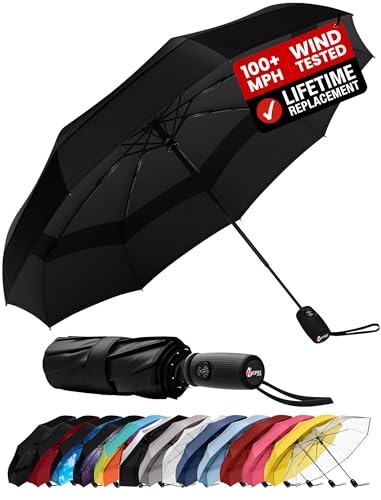
The Repel is the best-selling umbrella here and the one to beat on build. Its frame uses nine reinforced fiberglass ribs under a vented canopy, the combination that resists flipping and breaking rather than merely surviving a drizzle, and the maker cites testing to extreme wind speeds. One-touch automatic open and close means a single press deploys or folds it, which matters when your other hand is full. It weighs under a pound and folds to about twelve inches, so it disappears into a backpack, handbag, or car door, and the quick-dry canopy plus included case keep your bag dry afterwards. The ergonomic handle gives a secure grip when the wind is pulling.
The vented canopy is the detail that separates it from cheaper nine-rib frames. A second layer over an opening lets a gust pass through the top instead of pushing against a solid dome, which is what turns an ordinary umbrella into a sail and inverts it. Combine that with ribs that flex rather than crease and you have a frame that stays over your head in weather where others fail. Its size is the real trade: folded to about twelve inches it belongs in a backpack, a tote, or a car door rather than a coat pocket, and it costs more than the rest of this group. For an umbrella you rely on daily, both are easy to accept.
- Nine reinforced fiberglass ribs and a vented canopy
- One-touch automatic open and close
- Under a pound and folds to about twelve inches
- Wide canopy, quick-dry fabric, and a carry case
- Priciest of this group
- Too large for a small purse
Best for: commuters and travelers who want the most durable frame in a bag-friendly size.
Tumella Windproof Travel Umbrella
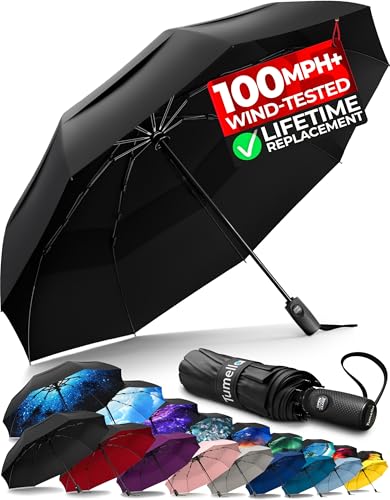
The Tumella takes direct aim at the category leader and undercuts it. Its frame uses nine full fiberglass ribs, and the brand makes a fair point about why that matters: many rivals mix fiberglass with metal, which creates a weaker joint that bends in stormy conditions. The canopy spans a generous forty-two inches, enough to keep a person and a bag dry, and automatic open and close works with one press for those in-and-out moments at the car or the office door. It folds to about eleven and a half inches and weighs under a pound, so it slips into a glove box or backpack, and a water-repellent sleeve comes with it. The maker backs it with long-term support.
The full-fiberglass argument is worth taking seriously rather than working on as sales talk. A rib made partly of metal has a junction where two materials meet, and a joint between a flexible material and a rigid one is exactly where stress concentrates and failure starts. A rib that is fiberglass end to end has no such transition, so it bends through its whole length and springs back. The forty-two-inch canopy is generous for something that folds under twelve inches.
- Nine full fiberglass ribs with no weaker metal mix
- Roomy canopy for a compact umbrella
- One-handed automatic open and close
- Folds small and weighs under a pound
- A less established name than the leader
- Still bag-sized rather than pocket-sized
Best for: anyone who wants leader-grade rib construction and coverage for less money.
Baodini Mini Travel Umbrella
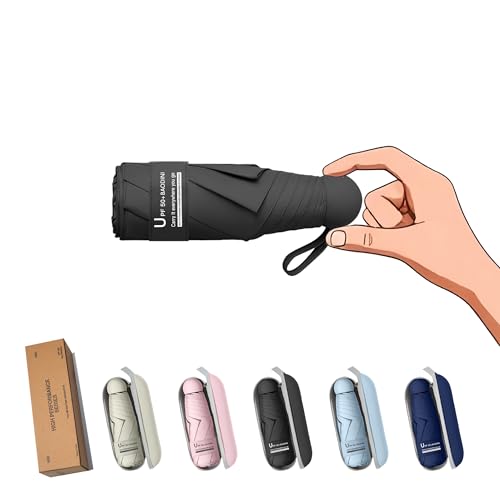
The Baodini is the pick when size beats everything. It folds to roughly seven inches, about the size of your palm, so it genuinely lives in a purse or a jacket pocket rather than being left at home. Its inner black-glue layer reflects most UV and the coating absorbs the rest for a UPF 50+ rating, which makes it as much a sun umbrella as a rain one, and the forty-inch arc still covers one person comfortably. It uses six reinforced fiberglass ribs, and the maker is refreshingly real that a pocket umbrella cannot be both featherlight and gale-proof: it handles gentle wind, not a storm. It opens and closes manually and comes with a case.
Credit where it is due: the maker’s own description states plainly that a compact umbrella cannot be flexible, lightweight, purse-sized, and gale-proof at once, and that six ribs are built to withstand a gentle wind. That clarity makes the decision easy. This is an umbrella for the drizzle, sun, and light breeze that make up most weather, and its real advantage is that it is with you, because the perfect storm umbrella left at home keeps nobody dry. Take it as everyday insurance rather than storm gear.
- Folds to about seven inches for pocket or purse carry
- UPF 50+ with a black inner coating for real shade
- Very light with a usable canopy for one
- Includes a case and a replacement warranty
- Six ribs handle light wind only
- Manual open and close, not automatic
Best for: purse and pocket carry, sunny climates, and anyone who wants an umbrella they never leave behind.
Rain-Mate Windproof Compact Umbrella
The Rain-Mate is the budget champion, and its approach to wind is pragmatic: eight reinforced fiberglass ribs with a fail-safe flip design, so instead of snapping under pressure the canopy inverts and flips back. That is a smart trade at this price, because the umbrella that survives is the one that gives way. You still get one-touch automatic open and close, a slip-resistant ergonomic handle for a secure hold in heavy rain, and a wide canopy that doubles as shade on clear days. It folds to about eleven inches, weighs under a pound, and comes with a durable case, making it an easy thing to keep in every bag and car you own.
The flip-safe approach is worth understanding, because it looks like failure and is not. When a gust overwhelms the canopy the ribs invert rather than resisting to the point of snapping, and once the pressure passes you pull it back into shape and carry on. You get briefly wet; you do not get a broken umbrella and a walk home. That is a smart choice at a price where a rigid frame would simply break, and it is the reason this is the one to buy in multiples: one in the car, one at the office, one in a backpack.
- Lowest price with genuine fiberglass ribs
- Flip-safe design inverts rather than breaking
- One-touch automatic open and close
- Comfortable non-slip handle and included case
- Eight ribs rather than nine
- Inverting in a gust means a wet moment before it resets
Best for: spares for the car, office, and backpack, or anyone who wants auto open and close for the least money.
Seniny Windproof Travel Umbrella
The Seniny is the all-rounder that quietly covers both jobs. It combines upgraded aluminum shafts with fiberglass ribs for a structure that stands up to wind and rain, and its high-density flexible fabric adds durability when the weather turns. The canopy runs about forty-two and a half inches, roomy enough for two at a pinch, yet it folds to twelve inches and weighs three-quarters of a pound so it still rides in a bag or car. Automatic open and close handles the one-handed moments. Its other half is sun: a premium coating gives UPF 50+ protection that blocks up to ninety-nine percent of UV, and the quick-drying fabric refolds without soaking everything.
The aluminum shaft is a deliberate choice rather than a cost saving. Steel is strong but heavy and rusts where water sits, whereas aluminum cuts weight and does not corrode, which is why it suits an umbrella carried every day and stored damp. Paired with fiberglass ribs you get a frame that resists both wind and time. This is the pick for anyone whose weather does two things at once: a serious canopy for a downpour and genuine UV blocking for a hot walk, without paying premium money.
- Aluminum shaft with fiberglass ribs for strength
- Roomy canopy that covers two at a pinch
- UPF 50+ coating blocks the vast majority of UV
- Automatic open and close, quick-drying fabric
- Slightly heavier than the smallest models
- Sun coating adds little for pure rain use
Best for: people who want one umbrella for downpours and hot sun without paying much.
Verdict
Best Overall: the Repel Windproof Travel Umbrella is the best seller here and the most complete package: nine fiberglass ribs, a vented canopy, automatic open and close, and a folded size that still fits a backpack. It is the one to buy if you want it to last.
Best Value: the Tumella matches the leader’s nine full fiberglass ribs and wide canopy for less, and the Rain-Mate is the budget pick with auto open and close and a flip-safe frame that shrugs off gusts.
Best for pocket and sun: the Baodini folds to about seven inches with UPF 50+ shade for purse carry, while the Seniny is the affordable all-rounder covering both rain and strong sun.
Frequently asked questions
Are the wind ratings on these umbrellas real? The dramatic figures come from each maker’s own testing, not an independent standard, so take them as marketing claims. Rib construction is the more dependable signal: full fiberglass ribs, a higher rib count, and a vented canopy genuinely handle gusts better.
Will a tiny pocket umbrella survive wind? Only light wind. A six-rib umbrella that folds to seven inches trades frame strength for pocketability, and real makers say so. If you regularly face storms, carry a nine-rib model that folds to eleven or twelve inches instead.
Is auto open and close worth it? If you often have a hand full, yes. One press deploys or folds the umbrella, which is genuinely easier at a car door or building entrance. Manual models are simpler and have one less mechanism to wear out.
Do these work as sun umbrellas? Several do. Look for a UPF 50+ rating and a black or dark inner coating, which together block the large majority of UV. Models with that coating are useful year-round rather than only when it rains.
How big a canopy do I need for two people? Arcs are measured along the curve, so the ground covered is less than the number suggests. Around forty inches suits one person, while forty-two inches and up shelters two if you walk close. Anything smaller is comfortably a solo umbrella.
Why do travel umbrellas break so often? Almost always at the joints, the runner, or the automatic mechanism rather than the fabric. Full fiberglass ribs and a vented canopy help most. So does letting it dry open before folding it away, since storing it soaked corrodes the mechanism that opens and closes it.
This article may contain affiliate links; see our Affiliate Disclosure.