In a small kitchen, counter space is the real currency, and an espresso machine is a permanent tenant. It sits there every day whether you use it or not, so the question is not just whether it makes good coffee. It is whether it earns the rectangle it occupies next to the kettle.



Compact machines split into three real categories: pump machines that make real espresso, capsule machines that trade control for speed, and low-pressure steam makers that produce something espresso-like for very little money. All three are represented here, and the right one depends less on your budget than on whether you want to weigh coffee at seven in the morning. These suit a studio kitchen, a shared house, an office corner, or a second machine that lives where the good one will not fit.
At a glance
| Product | Standout features | Price tier | Link |
|---|---|---|---|
| Gevi 20 Bar Espresso Machine | Pressure gauge, pre-infusion, NTC temperature control, all-steel body | Mid-range | |
| De’Longhi Classic Signature | 15-bar Italian pump, Thermoblock heating, preset single and double shots | Mid-range | |
| Nespresso Essenza Mini by Breville | Capsule system, 25-second heat-up, auto shut-off, capsules included | Premium | |
| IMUSA Electric Espresso Cappuccino Maker | 4-cup batch brewing, milk frother, permanent filter basket | Budget | |
| XIXUBX Compact Espresso Machine | 6 inches wide, 3.3 lb, one-knob control, 800W steam wand | Budget | |
How to choose a compact espresso machine
Measure the height, not just the width
Everyone measures the footprint and forgets the cupboard. A machine needs clearance above it to lift the lid and fill the tank, and if the tank comes out the top, that clearance is the machine’s height plus the tank again. Depth catches people too: the tank usually lives at the back, so a machine can be slim from the front and still need a deep counter. Only some listings publish dimensions, so check the specification before you commit. The XIXUBX is the most forthcoming here, listing 6 inches wide, 8.3 deep, 11.8 tall, at 3.3 pounds.
Bar pressure is the most misleading number in coffee
Real espresso is extracted at around 9 bar. When a machine advertises 15 or 20 bar, that is the pump’s maximum rating, not what reaches the coffee, and more is not better. What the number does tell you is the machine’s category. Anything at 15 or 20 bar, like the Gevi and the De’Longhi, is a pump machine capable of genuine espresso. Anything at 3.5 bar, like the XIXUBX, is a steam-driven maker: it heats water until pressure pushes it through the grounds, producing a mild espresso-style coffee rather than a true shot. Both make a drinkable cup with milk. Only one makes espresso.
Capsules against ground coffee
This is the real decision, and it is about your mornings rather than your palate. Capsules are consistent, quick, and leave nothing to clean; the Nespresso heats in 25 seconds and asks nothing of you. The costs are ongoing spend per cup, a limited range of what somebody else roasted, and packaging. Ground coffee in a pump machine costs far less per cup, works with any beans, and lets you fix a bad shot, but it needs a grinder to be worth doing well, and a grinder is another object on your counter.
Temperature stability is what a good shot depends on
Espresso is fussy about brew temperature, and the difference between machines is mostly how they hold it. Thermoblock heating, as on the De’Longhi, passes water through a heated block on demand, which is fast from cold and steady enough for back-to-back drinks. NTC sensors, as on the Gevi, monitor and correct the temperature rather than letting a thermostat drift. Both approaches beat a plain boiler that heats until a switch clicks.
The steam wand decides your milk
If you drink lattes and cappuccinos, this is the part that matters most. A proper wand lets you texture milk into microfoam, the fine glossy foam that pours; a weaker one makes stiff bubbles that sit on top like bath foam. Look for a wand that swivels far enough to hold a jug at an angle, and one that detaches for cleaning, since dried milk in a wand is both a hygiene problem and the reason a wand stops steaming. The Gevi’s froth nozzle is removable, and the De’Longhi’s wand has two settings.
What you will still need to buy
A pump machine’s cup quality is decided by grind, and pre-ground supermarket coffee is usually too coarse and too stale for espresso. Expect to add a burr grinder eventually, plus a tamper and a small jug for milk. The XIXUBX includes a measuring cup and the XIXUBX steel-bodied models include a frothing pitcher; the HBN listing helpfully specifies a medium-coarse grind, since too fine a grind will clog a low-pressure machine.
Gevi 20 Bar Espresso Machine
The best-selling machine of this group, and the one that gives a beginner the most room to improve. It has the two features enthusiasts look for and cheap machines skip: a pressure gauge, so you can see whether your grind is choking the shot or letting water rush through, and pre-infusion, which wets the puck gently before full pressure hits so the water does not carve a channel straight through it. NTC temperature control keeps the brew steady. The steam wand produces microfoam and its froth nozzle removes for cleaning, the housing is full stainless steel, and a hot water function covers Americanos, tea and pre-warming cups. Gevi backs it with a 12-month warranty and lifetime tech support.
Pros
- The best-selling pick here
- Pressure gauge, so you can actually diagnose a bad shot
- Pre-infusion for even extraction
- NTC temperature control
- Removable froth nozzle for easy cleaning
- Full stainless steel body; hot water function for Americanos
- 12-month warranty with lifetime tech support
Cons
- Dimensions are not published, so measure your space carefully
- Semi-automatic: results depend on your grind and technique
- Needs a grinder to be worth its features
Best for: learning to pull a real shot, and anyone who wants to see what the machine is doing.
De’Longhi Classic Signature
The second best-seller, and the most polished pump machine here. Its 15-bar Italian pump is the conventional, correct specification for home espresso, and Thermoblock heating means it comes up to temperature almost immediately and holds it precisely rather than cycling around it. The convenience feature that earns its place daily is customisable preset recipes: set your single and double shot volumes once and the machine doses them automatically, so a weekday morning does not involve watching a cup and guessing. The steam wand has two settings, from steamed milk for a flat white to velvety microfoam for latte art, and it handles milk alternatives. The stainless steel body is designed to be narrow and unobtrusive.
Pros
- 15-bar Italian pump, the standard specification for home espresso
- Thermoblock heating: fast from cold, stable in use
- Programmable single and double shot volumes
- Two-setting steam wand, works with milk alternatives
- Compact stainless steel design
- Second best-selling machine here
Cons
- No pressure gauge to diagnose extraction
- Dimensions are not published on the listing
- Among the pricier machines in this group
Best for: daily lattes and cappuccinos with the least fuss, from a machine that still makes real espresso.
Nespresso Essenza Mini by Breville
The machine for people who want coffee, not a hobby. Drop in a capsule, press a button, and 25 seconds after a cold start there is espresso in the cup with no grinder, no tamping, no dialling in, and nothing to clean but a used capsule. It is designed to be small and light enough to move around a kitchen rather than being installed in one, and an automatic shut-off means it is not quietly drawing power all day. A starter set of capsules comes in the box, so it works the moment it arrives. The trade is fair and permanent: you are buying into a capsule system, so the coffee costs more per cup and comes from one supplier’s range. There is no steam wand on this model, so milk drinks need a separate frother.
Pros
- 25-second heat-up, then a shot at the press of a button
- No grinder, tamper or technique required
- Genuinely small and easy to move or store
- Energy-saving automatic shut-off
- Starter capsules included
- Consistent results from the first cup
Cons
- Highest price here, and capsules cost more per cup than beans
- Locked to one capsule range
- No steam wand: milk drinks need a separate frother
Best for: quick weekday espresso, guests, offices, and anyone who will not maintain a pump machine.
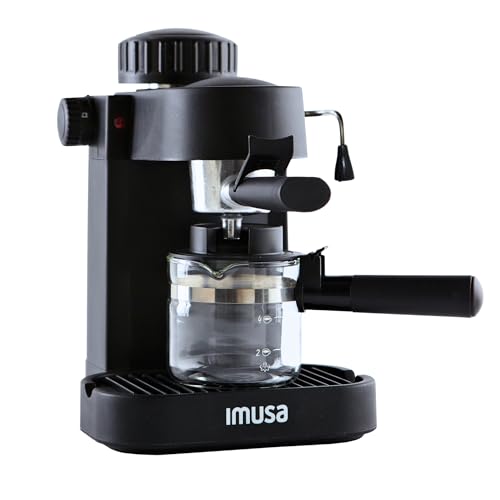
IMUSA Electric Espresso Cappuccino Maker
This one is aimed squarely at a tradition rather than a spec sheet: strong, small, dark coffee brewed four cups at a time, the way Cuban coffee is made and shared. That batch approach is the point and the difference. Where every other machine here pulls one shot at a time, this fills four cups in a go, which suits a household where two or three people all want coffee at once rather than queuing at a portafilter. A milk frother handles cappuccinos and lattes. The body is heat-resistant plastic that keeps hot internals away from hands, the drip tray removes, and the filter basket is permanent, so there is nothing to buy and nothing to throw away. It runs on standard 120V.
Pros
- Brews four cups at once, not one shot at a time
- Very cheap, and cheap to run with a permanent filter
- Milk frother included for cappuccinos and lattes
- Removable drip tray, straightforward cleanup
- Heat-resistant body keeps hot parts away from hands
- Built for the strong, small-cup Cuban coffee style
Cons
- No published pump pressure, so do not expect a true 9-bar shot
- Plastic body rather than steel
- Dimensions are not published
- Batch brewing gives you little control over any single cup
Best for: households making several small strong coffees at once, and Cuban-style coffee at home.
XIXUBX Compact Espresso Machine
The smallest and cheapest machine here, and the only one that tells you exactly how much counter it takes: 6 inches wide, 8.3 deep, 11.8 tall, weighing 3.3 pounds. That is narrower than most kettles and light enough to put in a cupboard between uses, which is a real answer for a kitchen with no spare space. It runs a 3.5-bar system, so be clear about what that means: it is a steam-driven maker producing a gentle, mild, low-bitterness brew rather than a true espresso shot. The 800W steam wand is the surprise, producing genuine microfoam for lattes in seconds. Operation is one mechanical knob with three positions, brew, steam and off, so there is nothing to learn. It includes a splash-proof BPA-free measuring cup, a safety lock, and a one-year warranty.
Pros
- Cheapest machine here, and the smallest published footprint
- 6 inches wide and 3.3 lb: fits or stores almost anywhere
- Dimensions actually published, unlike most rivals
- 800W steam wand makes real microfoam
- One-knob operation: brew, steam, off
- Safety lock and a one-year warranty
Cons
- 3.5 bar is a steam maker, not true espresso
- Mild brew that will not satisfy a shot drinker
- Too fine a grind will clog it
- Plastic-bodied and small-tanked
Best for: dorms, offices, RVs and the tightest kitchens, especially for milk drinks rather than straight shots.
The verdict
Best overall: Gevi 20 Bar Espresso Machine. It is the best-selling machine of this group and the one that gives the most back over time. A pressure gauge and pre-infusion are features usually found much further up the price ladder, and they turn espresso from guesswork into something you can read and correct. Add a decent grinder and it will keep improving with you.
Best value: XIXUBX Compact Espresso Machine. For the least money and the least counter, you get a real steam wand and a genuinely mild, pleasant milk-drink base. Be clear with yourself about the 3.5-bar limitation and it is hard to beat for a small space. The IMUSA is the better cheap pick if you need four cups at once rather than one.
Best premium: Nespresso Essenza Mini by Breville. It is the most expensive machine here and the least involved, which is exactly the point: 25 seconds from cold to espresso, nothing to clean, nothing to learn. If you want that convenience with real espresso from your own beans instead, the De’Longhi Classic Signature and its programmable shots is the machine to buy.
FAQ
Is a 20-bar machine better than a 15-bar one?
No. Espresso is brewed at roughly 9 bar, and both figures describe a pump’s maximum, not what reaches the coffee. Take 15 and 20 bar as meaning the same thing: a real pump machine. The number that genuinely matters is at the other end, since a 3.5-bar machine is a steam maker in a different category altogether.
Do I need a separate grinder?
For a pump machine, effectively yes if you want good espresso. Grind size is the main control you have over a shot, and pre-ground coffee is usually both too coarse for espresso and stale by the time it reaches you. A burr grinder is the single upgrade that improves a cheap machine most. Capsule machines like the Nespresso sidestep this entirely.
How small do these actually get?
Smaller than most people expect, but check the listing rather than the photo. The XIXUBX publishes 6 inches wide, 8.3 deep and 11.8 tall, which fits almost any counter. Several other machines here describe themselves as compact without giving numbers, so measure your gap, including the clearance above for filling the tank, and confirm the specification before ordering.
Can I make a latte on all of these?
On four of the five. The Gevi, De’Longhi, IMUSA and XIXUBX all include steam wands or frothers. The Nespresso Essenza Mini in this configuration has no wand, so milk drinks need a separate frother, which is another small object on a counter you were trying to protect.
Why does my espresso taste sour or bitter?
Sour usually means under-extraction: the water moved through too fast, so grind finer or tamp more evenly. Bitter usually means over-extraction: too fine, too slow, or too hot. This is exactly what the Gevi’s pressure gauge is for, since it shows which of the two is happening instead of leaving you to guess. On a low-pressure machine, note the general advice to keep the grind medium-coarse, because too fine will simply clog it.
This article may contain affiliate links; see our Affiliate Disclosure.