Steel against steel only ever ends one way, and the bar is what loses. Drop a loaded barbell into a bare metal cup a few hundred times and the evidence shows up in a bright polished stripe where the finish used to be, knurl worn flat exactly where the cup bites, and a clang loud enough to carry through the house. The pad on a J-cup is the cheapest insurance a barbell will ever get.

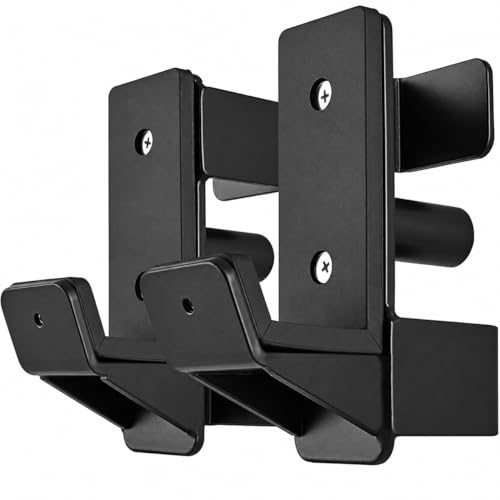


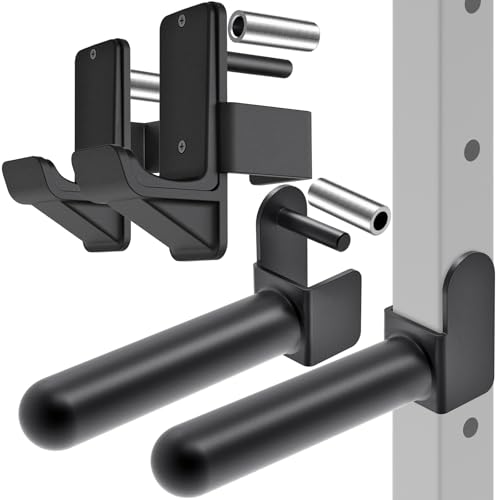
A good J-cup does three jobs at once: it holds a heavy bar without flexing, it puts something soft between the bar and the steel, and it lets go cleanly when you drive out of the hole. The five below cover the range from a bare-bones plastic-padded pair to a set that brings plate storage along with it. Anyone with a 2×2 or 3×3 upright and a bar worth keeping will find a fit here.
| Product | Standout feature | Price tier | Link |
|---|---|---|---|
| Yes4All Power Rack J-Hooks | 8 mm plastic pad, 6 mm steel, sold for 2×2 and 3×3 uprights | Budget | |
| AINAFIX J Hooks for 2×2 Power Rack | Thick rubber pads, bottom-reinforced double-bracket cup | Mid-range | |
| SELEWARE J Hooks for Power Rack | 1500 lb per-hook rating with no bottom support needed | Mid-range | |
| SYL Fitness J-Hooks for Squat/Power Rack | UHMW pads, the slickest pad material in this group | Mid-range | |
| Kipika J-Hooks and Weight Plate Holder Set | J-cups plus plate storage in one purchase, 8 mm rubber pads | Premium | |
How to choose J-cups that fit and protect
Measure the upright before you read another word
This is where most of the returns come from. J-cups are cut for a specific upright, and there are two numbers that matter: the tube size and the hole size. Tubes are usually 2 inches square or 3 inches square. Holes are usually 1 inch or 5/8 inch. Every listing in this group leads with a warning to check, and they are not being polite, they are being accurate. A 2×2 cup on a 3×3 upright does not sit loose, it does not go on at all. Take a tape to the tube and a caliper or a drill bit to the hole, and write both numbers down before ordering. Some ranges cover both sizes under one listing, so read which variation you are actually adding to the cart.
Pad material is the whole knurl question
Three materials show up here, and they behave differently. Plastic is the common default and does the basic job: it stops metal touching metal and takes the edge off the noise. Rubber is softer and deadens more of the impact, at the cost of gripping the bar a little as you rack. UHMW is the interesting one, a dense slippery plastic that resists gouging and lets the bar slide across it rather than catch. Thickness matters as much as the material. An 8 mm pad has enough depth to absorb a hard rack; a thin skin gets compressed and eventually cut through, and then you are back to steel on steel without noticing the day it happened. Check pads once a season and take a worn one as a consumable, not a failure.
Capacity ratings and what they actually tell you
The numbers in this group run from 500 lb per hook to 1500 lb per hook, and a lifter comparing them should hold two thoughts at once. First, almost nobody benches or squats near even the lowest of these figures, so raw capacity is rarely the deciding factor. Second, the rating is still a useful proxy for how much steel is in the part and how it is put together. A cup rated for 1500 lb is built with more material than one rated for 500 lb, and that extra material shows up as less flex and less wobble under a bar you can actually lift. Read the rating as a description of construction, not as a limit you plan to approach.
Welded, reinforced, or unsupported
Look at how the cup meets the post that goes into the rack. Some designs are fully welded. Some add a bottom bracket that transfers load into the upright below the hole. Others are cut and formed so no bottom support is needed at all. All three approaches work; what they change is how the cup behaves when a bar lands off-center and tries to twist it. A double-bracket or bottom-reinforced cup resists that twist best. A design with no bottom support keeps the upright cleaner and is quicker to move between holes. Neither is wrong, but a rack that already wobbles will feel worse with the lighter design.
Cup depth and the drive out of the hole
A deep cup holds the bar securely and is forgiving when you rack tired, which is exactly when you need forgiveness. A shallow cup lets you clear the bar with a smaller lift-off, which matters for a heavy squat where every wasted inch costs you. Shorter designs are advertised for that reason. If you unrack a squat and immediately walk it back, shallow is your friend. If you bench alone and want the bar to stay put when you set it down badly, depth wins.
Yes4All Power Rack J-Hooks: Best Overall
The most-bought J-cups in this comparison, by a clear margin, and the specification explains why without any drama. Six millimeters of steel plate under black paint, an 8 mm plastic pad thick enough to matter, 500 lb per hook and 1000 lb for the pair. The design is deliberately shortened so racking and unracking does not demand a lift you did not plan for, and height changes take seconds on the 1-inch locating bar. It is the plain, correct answer for a 2×2 rack with 1-inch holes, and there is a 3×3 version in the same range with a lock knob added.
Pros
- 8 mm plastic pad, thick enough to take repeated hard racking
- 6 mm steel plate with a paint finish that holds up against corrosion
- Shortened profile makes unracking and re-racking less awkward
- Height adjusts in seconds with no tools
- Budget tier, and the best seller of this group
Cons
- 500 lb per hook is the lowest rating here, though still beyond most lifters
- Plastic pad rather than rubber or UHMW
- Fits most 2×2 racks with 1-inch holes, but not all; measure first
- No lock knob on the 2×2 version
Best for: anyone with a standard 2×2, 1-inch-hole rack who wants proven, no-nonsense cups.
AINAFIX J Hooks for 2×2 Power Rack
This is the one listing in the group that names the problem this article is about. AINAFIX talks specifically about protecting barbell knurling and avoiding rack scratches, and backs it with thick rubber pads rather than plastic. The build addresses the other half of the equation too: a bottom-reinforced cup and a double-bracket structure, aimed squarely at the wobble you feel when a heavy bar lands slightly off-center. Rated at 600 lb per hook and 1200 lb for the pair. Hole sizes come in 1/2, 5/8, and 1 inch, so the variation you pick has to match your rack exactly.
Pros
- Thick rubber pads, chosen specifically to protect knurling and finish
- Bottom-reinforced cup with a double-bracket structure to cut wobble
- 600 lb per hook, 1200 lb per pair
- Offered in 1/2, 5/8, and 1 inch hole variations
- Second-best seller in this comparison
Cons
- Rubber grips the bar slightly more than slick UHMW during a rack
- Pad thickness is described as thick but never given a figure
- 2×2 uprights only
- Priciest of the mid-range options here
Best for: lifters with a bar finish worth protecting who want the pad to be the point, not an afterthought.
SELEWARE J Hooks for Power Rack: Best Value
Fifteen hundred pounds per hook is the largest number on this page, and SELEWARE gets there with an unusual approach: no welds and no bottom support bracket. The cup is formed to carry the load through its own geometry instead of through a joint, which removes the weakest point in most cup designs, since a weld is where a cheap cup fails first. A powder-coated finish handles the humidity of a garage better than paint. The pad is plastic rather than rubber, which is the trade for the price. Between lifts they double as barbell storage, which quietly solves where the bar lives.
Pros
- 1500 lb per hook, the highest rating in this comparison
- No welds, so there is no weld to fail
- Powder-coated finish resists rust better than paint
- Slide the pin in and swing down to lock; no tools, no fiddling
- Doubles as barbell storage when you are done
Cons
- Plastic pad, not rubber or UHMW
- 2×2 uprights with 1-inch holes only in this variation
- Pad thickness is not specified
- No lock knob to stop the cup lifting on a rough re-rack
Best for: anyone who wants the most steel and the fewest failure points for a mid-range spend.
SYL Fitness J-Hooks for Squat/Power Rack
UHMW is the reason to look here. It is the dense, slippery plastic used where things slide against each other for a living, and as a J-cup liner it does something the softer materials cannot: it takes a hard landing without gouging, and it lets the bar move across the surface rather than grabbing at it. For a bar with a finish you care about, that combination is the gentlest product in this group. The rest of the cup is heavy-duty steel rated to 1000 lb for the pair, offered for both 2×2 and 3×3 uprights. SYL publishes less detail than the others, so what you see is genuinely what you get.
Pros
- UHMW pads resist gouging and let the bar slide instead of catching
- Heavy-duty steel rated to 1000 lb for the pair
- Sold in both 2×2 and 3×3 versions under one range
- Suits shrugs, presses, and curls as readily as bench work
Cons
- The listing gives very little specification detail
- No per-hook rating published, only the pair figure
- Pad thickness not stated
- Sells in lower volume than the leaders here
Best for: owners of a well-finished bar who want the slickest, least abrasive liner available in this group.
Kipika J-Hooks and Weight Plate Holder Set: Best Premium
Two problems, one box. The J-cups are the strong part: 8 mm rubber pads that damp noise and vibration and keep the bar off bare steel, on hooks rated to 1500 lb each, in powder-coated steel. The plate holders bolt the other half of a tidy gym onto the same uprights, taking plates off the floor and putting them where your hands already are, rated to 300 lb each. Everything pins and swings into place without tools. One caution worth knowing before you order: the listing describes the plate holder’s plate size inconsistently between the title and the details, so confirm it fits the plates you own.
Pros
- 8 mm rubber pads, the thickest stated pad in this comparison
- 1500 lb per J-hook, matching the strongest here
- Plate holders included, rated to 300 lb each
- Powder-coated steel throughout, no tools needed to fit or adjust
- Covers 2×2 uprights with either 5/8 or 1 inch holes
Cons
- The listing contradicts itself on which plate size the holder takes
- Premium tier, roughly double the budget option
- 2×2 uprights only
- Lowest sales volume in this group
Best for: someone setting up a rack from scratch who wants cups and plate storage sorted in one order.
Verdict
Best Overall: Yes4All Power Rack J-Hooks. The clear best seller here, and deservedly plain about it: thick steel, an 8 mm pad, a shortened profile that makes racking easier, and a budget price. The 500 lb per-hook rating is the lowest in this group and still comfortably past what almost anyone will put on it.
Best Value: SELEWARE J Hooks for Power Rack. Triple the capacity rating of the budget pick for a modest step up in price, with no weld to crack and a powder-coated finish. You give up the softer pad to get it.
Best Premium: Kipika J-Hooks and Weight Plate Holder Set. The thickest rubber pads, the top capacity rating, and plate storage in the same order. Worth it if you are outfitting a rack, hard to justify if you only need cups.
FAQ
Will J-cups really damage a barbell?
An unpadded cup will, over time. The contact patch is small and the load is large, so every rack presses bar finish against hard steel. What you see first is the finish wearing through to bright metal, then the knurl points flattening where the bar sits. It is slow and it is cosmetic long before it is functional, but it does not reverse. A pad costs a fraction of a bar and stops the process entirely.
Which pad material protects a bar best?
UHMW has the best combination for a bar you care about, because it is hard enough not to gouge and slick enough that the bar slides rather than catches. Thick rubber deadens impact and noise the most, which is the better trade in a shared house. Plastic is the common default and is perfectly adequate. Thickness counts too, so an 8 mm pad of any of these beats a thin one.
How do I know if I need 2×2 or 3×3 cups?
Measure the square tube of your rack upright, then measure a hole. Those two numbers, tube size and hole diameter, decide it completely. Most home racks are 2×2 with 1-inch holes; heavier racks tend to be 3×3 with 5/8-inch holes. There is no universal J-cup, and no cup that adapts across sizes without an adapter designed for it.
Do higher capacity ratings matter for a home gym?
Not as a limit, since even the 500 lb per-hook rating here sits well above what most people rack. It matters as a hint about construction. Higher-rated cups carry more steel and are put together to resist twisting, and that shows up as less wobble on a bar that lands off-center. Buy the rating for the stiffness, not for the ceiling.
Can J-cups double as barbell storage?
Yes, and several here say so directly. Leaving a bar in the cups between sessions is fine and keeps it off the floor. The one thing to watch is leaving a loaded bar sitting in cups for weeks at a time, which puts a constant load on one small patch of pad. Strip the bar down and the pad lasts longer.
This article may contain affiliate links; see our Affiliate Disclosure.