There is a moment at the bottom of a heavy squat where the knees decide whether the rep is happening. A good pair of sleeves does not lift the bar for you, but they keep the joint warm, snug, and tracking straight, and they give back a little at the exact point you need it most. That is why the 7mm neoprene sleeve became standard kit on every platform in the world.


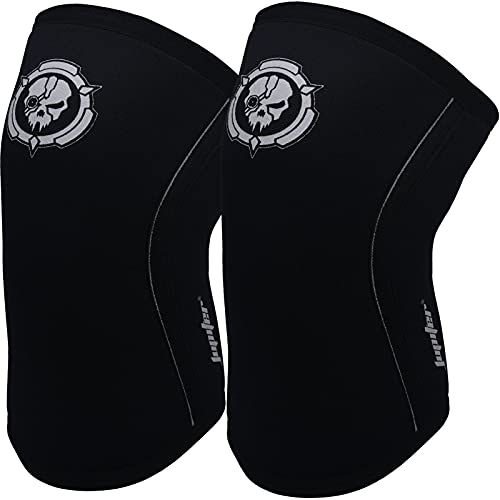

Three things separate sleeves worth owning from sleeves that end up in a drawer: neoprene thickness, whether the seams survive a year of heavy training, and whether they stay put instead of rolling down your calf mid-set. Whether you are chasing a competition total, training around cranky knees, or just want your working sets to feel more solid, the same short list decides it.
At a glance
| Product | Standout features | Price tier | Link |
|---|---|---|---|
| Gymreapers Knee Sleeves | Best seller of this group; 7mm; IPF approved for tested competition; reinforced stitching; storage bag included | Premium | |
| Iron Bull Strength Knee Sleeves | 7mm; anti-slip inner grip stops rolling; unconditional Iron Clad warranty | Premium | |
| Rehband Knee Sleeve | 5mm SBR neoprene; patented 4-panel anatomical shape; handcrafted in Europe; sold as a single sleeve | Mid-range | |
| Jupiter Knee Sleeves | 7mm at the lowest tier; washable; sold as a pair | Budget | |
| Phantom Athletic Club Knee Sleeves | 7mm; IPL, USPA and IWF compliant; 11 inch length; single-seam build; four sizes | Budget | |
How to choose knee sleeves
5mm or 7mm, and why almost everything is 7mm
Thickness is the main decision, and the reason the market clusters at 7mm is regulatory: most powerlifting federations cap legal sleeves at 7mm, so that is where support-focused brands build. Thicker neoprene compresses harder, holds more heat, and stores a little elastic energy that gives a modest push out of the bottom of a squat. It also fights you getting it on, restricts the knee slightly through deep flexion, and gets sweaty fast. Rehband’s 5mm is the counterweight: less squeeze, far more freedom, and much more tolerable across a long session with lots of movement. Iron Bull is blunt that most sleeves are 5mm and it chose 7mm deliberately for deeper compression under maximal load. Both positions are correct; they answer different questions.
What a sleeve is, and what it is not
A compression sleeve is not a brace. It has no hinges, no straps, and no rigid uprights, so it does not stop a knee from moving in a direction it should not go. What it does is apply even pressure around the joint, keep the tissue warm, and improve your sense of where the joint is in space. Knee wraps are a different tool again: they are wound on tightly for a single maximal attempt and produce far more rebound, at the cost of comfort and circulation. Sleeves are what you wear for the whole session. If you have a diagnosed injury or you are working through rehabilitation, that is a conversation with a clinician, not a purchase decision.
Competition legality
This matters more than people expect, and only if you compete. Gymreapers lists IPF approval, which is the standard that tested federations follow and the strictest bar in the group. Phantom lists IPL, USPA, and IWF compliance, covering the untested powerlifting federations and Olympic weightlifting. Rehband states its sleeves have been tested in competition without naming a federation, and Iron Bull’s approval language is general rather than specific. If a meet is on your calendar, check your federation’s current approved list before you buy, because those lists change and the answer at the equipment check is final.
Sizing is the thing people get wrong
Sleeves are sized on a measurement, not on your shoe size or your usual shirt. Element-style guidance across this category is consistent: measure your leg circumference a few inches above the kneecap and buy from the chart. Phantom adds the advice that matters most, which is to size up if you are between sizes or carry big quads and calves, because a sleeve tight enough at the knee can be impossible to pull over a large calf. Expect a fight getting them on. That is normal, and a sleeve that slides on easily is too big to do anything useful.
Pairs, singles, and the small print
Read the quantity before you check out. Gymreapers, Jupiter, and Phantom all ship as a pair, two sleeves in the box. The Rehband listing here is a single sleeve, which is deliberate rather than a mistake, since a lot of athletes only need support on one knee and the design fits either leg. If you want two, you buy two, and the price tier changes accordingly. It is the most common surprise in this category.
Gymreapers Knee Sleeves
The best seller of this group, and the one with the credential that actually costs a brand something: IPF approval. That single fact tells you the construction meets the strictest measured standard in the sport, and it is why these show up under so many singlets. The 7mm neoprene is built for maximal work, with reinforced stitching against the seam failures that end cheaper sleeves, a sweat-resistant, form-fitting cut that stays put through squats, cleans, and jumps, and a reinforced storage bag so a damp pair is not loose in your gym bag. Sold as a pair, in a straightforward black.
Pros:
- IPF approved, the strictest federation standard here
- 7mm neoprene built for maximal squats and pulls
- Reinforced stitching for long-term durability
- Stays put without slipping or bunching
- Reinforced storage bag included; sold as a pair
Cons:
- Premium price tier
- 7mm is a genuine effort to put on
- More sleeve than a general fitness routine needs
Best for: anyone squatting heavy who wants competition-legal sleeves that will still be intact in a few years.
Iron Bull Strength Knee Sleeves
Refreshingly real about what it is for. Iron Bull states plainly that these were built for the barbell and not the treadmill, and the whole design follows that logic. The 7mm neoprene targets deeper compression, more joint warmth, and support at maximal load, and the feature that separates it from the pack is an anti-slip inner grip that locks the sleeve in position rep after rep. Anyone who has spent a set hitching a sleeve back up over the kneecap will recognize the value. Targeted compression around the patella is the pitch, backed by an unconditional warranty, and they come as a pair in charcoal.
Pros:
- Anti-slip inner grip genuinely stops rolling and sliding
- 7mm neoprene for deep compression and warmth
- Unconditional Iron Clad warranty
- Clear about the intended use: barbell work
- Sold as a pair
Cons:
- No named federation approval, unlike the Gymreapers
- Premium tier with no storage bag included
- Explicitly not intended for running or treadmill work
Best for: lifters whose sleeves keep migrating down their shins mid-session.
Rehband Knee Sleeve
The outlier here, and the most interesting one. At 5mm of SBR neoprene it deliberately trades squeeze for mobility, which is the right call the moment your training includes anything other than slow, heavy squats. The patented four-panel design is the real engineering: rather than a straight tube, the sleeve is shaped to the anatomy of a bent knee, so it conforms instead of bunching behind the joint. It is handcrafted in Europe, fits either leg, and Rehband works directly with strength athletes to refine the design. Note the quantity carefully. This listing is one sleeve, not two.
Pros:
- 5mm keeps the knee mobile through deep flexion and long sessions
- Patented 4-panel design conforms to a bent knee
- Handcrafted in Europe from SBR neoprene
- Fits either the left or right leg
- Refined with input from competing strength athletes
Cons:
- Sold as a single sleeve, so a pair costs double
- 5mm gives less support than 7mm at maximal loads
- No specific federation approval named
Best for: mixed training with lots of movement, and anyone who only needs support on one knee.
Jupiter Knee Sleeves
The entry point, and the value case is simple: this is a genuine 7mm pair at roughly half what the premium brands ask. Heavy-duty neoprene and a secure seam handle the forces and friction of squats and lunges, and the sleeves are lightweight enough to keep a full range of movement while still applying real compression. Jupiter’s angle is the recovery side of the equation, describing the sleeve as supporting blood flow around the joint and taking the edge off the sudden twists that turn into missed weeks. They are washable, which matters more than it sounds, and they come as a pair.
Pros:
- Full 7mm thickness at the lowest price tier here
- Sold as a pair; washable
- Heavy-duty neoprene with a secure, reinforced seam
- Lightweight enough to preserve range of movement
Cons:
- No federation approval listed, so unreliable for tested meets
- No storage bag or anti-slip grip
- Listing markets running use, which suits thin sleeves rather than 7mm neoprene
Best for: a first pair of sleeves, or a spare set to leave in the car.
Phantom Athletic Club Knee Sleeves
The most specification-dense listing at the budget tier, and it earns attention. Three federations are named as compliant, IPL, USPA, and IWF, which covers untested powerlifting and Olympic lifting and is unusual at this price. The build is single-seam, which removes the most common failure point, and the 11 inch length is stated rather than left vague, so you know how much of the leg is covered. Phantom is also the only listing here that tells you what to do if you are between sizes, which is to go up, particularly with large calves or quads. Four sizes, sold as a pair.
Pros:
- IPL, USPA, and IWF compliant at a budget price
- Single-seam construction removes a common failure point
- Stated 11 inch length and four sizes
- Clear, useful sizing guidance for larger legs
- 7mm neoprene; sold as a pair
Cons:
- Not IPF approved, so not for tested federation meets
- Black only
- No storage bag
Best for: untested meets and Olympic lifting, where the approval list is satisfied without paying a premium.
The verdict
Best Overall: Gymreapers Knee Sleeves. The best seller of the group, and the IPF approval backs up the popularity with something measurable. You get 7mm of support that is legal in the strictest federations, reinforced stitching where cheap sleeves split, and a bag to keep them in. For anyone squatting seriously, this is the safe answer.
Best Value: Phantom Athletic Club Knee Sleeves. Three federation approvals, single-seam construction, a stated length, and real sizing advice, all at the budget tier. Unless your meet specifically requires IPF-approved gear, it is difficult to justify spending double. The Jupiter pair costs about the same if you simply want 7mm and no paperwork.
Best Premium: Rehband Knee Sleeve. An unusual premium pick, because you are paying for restraint rather than more neoprene. The 5mm four-panel design is the most comfortable thing here across a long, varied session, and it is handcrafted rather than mass-produced. Buy two if you need two.
Frequently asked questions
Do knee sleeves actually add to your squat?
A little, and less than the marketing suggests. Thick neoprene stores a small amount of elastic energy as you descend and returns some of it out of the bottom, which is worth a few pounds rather than a new category of strength. The larger benefits are warmth, consistent compression, and better joint awareness, all of which make heavy sets feel more repeatable. Knee wraps produce far more rebound, which is exactly why federations classify them separately.
Should I buy 5mm or 7mm?
Pick 7mm if your training centers on heavy squats and maximal attempts, and you want the most support and warmth available within the rules. Pick 5mm, like the Rehband, if your sessions mix lifting with conditioning, lots of knee flexion, or long durations where a 7mm sleeve becomes hot and restrictive. Many people who train both ways end up owning both.
Can I run in these?
These are not running sleeves, and Iron Bull says so directly in its own listing: built for the barbell, not the treadmill. Thick neoprene traps heat and restricts the repeated, rapid knee flexion running demands, so a 7mm powerlifting sleeve is the wrong tool even where a listing markets it as versatile. For running, look at thin compression sleeves designed for the job, which are a genuinely different product.
Why do my sleeves smell, and how do I wash them?
Neoprene holds moisture, and moisture plus body heat is the whole problem. The fix is routine rather than clever: take them out of the bag after every session and let them air dry fully instead of leaving them rolled up damp. Hand wash in cold water with a mild soap and air dry. Skip the tumble dryer, which cooks the neoprene and weakens the seams. A storage bag like the one Gymreapers includes helps in transit, but only if the sleeves go in dry.
How tight should they be?
Tight enough that getting them on takes real effort, and no tighter. Measure your leg above the kneecap and follow the brand’s chart rather than guessing. A sleeve that slides on comfortably is not compressing anything. One that leaves your foot tingling or your calf numb is too small. If you are between sizes, or your calves and quads are well developed, size up.
This article may contain affiliate links; see our Affiliate Disclosure.