By three in the morning your top leg has slid forward, your pelvis has rolled with it, and your lower back is quietly paying the bill for both. A knee pillow is a small block of foam whose only job is to stop that slide – and the difference between one that works and one that ends up on the floor comes down to a few details nobody puts on the box.




A knee pillow either holds its height under the weight of a leg for eight hours or it slowly pancakes and stops doing anything. That single property – density that survives the night – separates the good ones from the drawer-filler. The five below span a cheap first try, the shape most of the market copied, and a washable option for anyone who runs hot or dislikes foam entirely.
At a glance
| Product | Standout feature | Price tier | Link |
|---|---|---|---|
| BlissTrends Memory Foam Knee Pillow | High-density foam at the lowest entry cost; washable cover | Budget | |
| Contour Legacy Leg & Knee Pillow | Hourglass shape that supports legs and knees together; ventilated foam | Premium | |
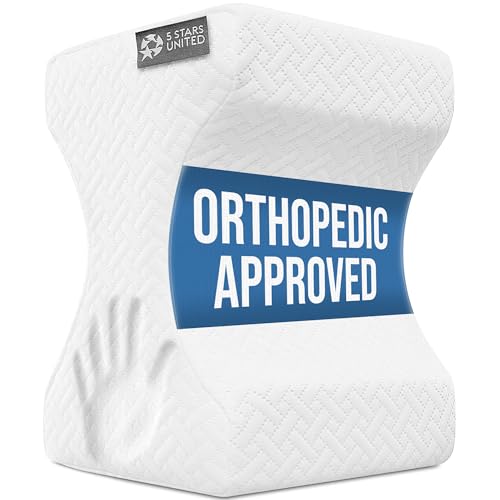
| 5 STARS UNITED Knee Pillow | Chiropractic-association endorsed; OEKO-TEX and CertiPUR certified | Mid-range | |
| Vertdens Leg Pillow | Contoured thigh cradle; light enough to travel with | Mid-range | |
| MINUPWELL Knee Pillow | Down-alternative fill, fully machine washable, no foam smell | Mid-range | |
How to choose a knee pillow that actually stays put
Height is the whole argument
The pillow’s job is to fill the gap between your knees so your top leg sits level with your hip instead of dropping toward the mattress. That gap is set by the width of your hips relative to your knees, so there is no universal correct height. Broader hips need more foam; a narrower frame gets pushed out of alignment by a tall pillow, which is its own kind of ache. Most of the pillows here land between roughly five and seven inches thick. If you are unsure, err slightly low – a pillow that is a touch short still helps, while one that is too tall props your top leg above your hip and rotates the pelvis the other way.
Density beats softness
A knee pillow that feels luxurious in your hands is often the one that flattens by midnight. The whole load of a leg presses on a small footprint for hours, and low-density foam simply gives up. High-density memory foam feels firmer than you expect at first and is the correct choice. The same logic applies to rebound speed: a foam that takes several seconds to spring back is holding structure, whereas one that snaps back instantly tends to push against you when you shift.
Straps solve a problem you may not have
Strapped pillows promise the pillow will never migrate. In practice, straps are polarizing. They keep the foam anchored if you are a heavy turner, but they also bind the thigh, and anything that constricts a leg through the night is a trade-off worth thinking about rather than assuming. A well-shaped pillow with a proper contour usually holds position on friction alone. Try unstrapped first; reach for a strap only if you genuinely wake up to find the pillow gone.
Covers, heat and washing
Memory foam holds body heat, which is exactly what you do not want between your legs on a warm night. Ventilated foam, gel layers, and breathable knit covers all help a little; none turn foam into a cooling device. Every pillow here has a removable cover, but only one is washable as a whole unit. If the idea of a foam core you can never clean bothers you, that distinction matters more than any feature on the list.
Shape: hourglass, wedge, or long
The hourglass profile – narrow in the middle, flared at both ends – cradles the calf as well as the knee and is the shape most of the category imitates. A simple contoured wedge is lighter and easier to pack. Longer designs support the thigh down to the ankle, which suits anyone whose lower leg dangles unsupported and aches by morning.
Your mattress changes the answer
A soft mattress lets your hip and shoulder sink in, which partly closes the knee gap on its own – a tall pillow on a plush bed can over-correct and lift the top leg past level. A firm mattress does the opposite: the hip stays high, the gap stays wide, and a thin pillow barely registers. This is the most common reason a pillow that a friend swears by does nothing for you. It is also why free returns are worth more here than in most categories, and why several people end up on their second try rather than their first.
What a knee pillow will not do
It is worth being clear about the limits. A knee pillow changes the geometry of your legs and pelvis while you sleep. It does not handle sciatica, repair a joint, or fix a hip problem with a cause outside the bedroom. What it can do is remove one nightly aggravator, and for a lot of people that is enough to change how mornings feel. If pain wakes you regularly, is getting worse, or radiates down the leg, a pillow is a comfort measure alongside proper advice, not a substitute for it.
BlissTrends Memory Foam Knee Pillow
This is the one people buy when they are not yet convinced a knee pillow will do anything, and it is the best seller of the group by a wide margin. At roughly 10 by 7.9 by 5.7 inches it sits in the middle of the useful height range, and the maker specifies high-density foam rather than the vague “memory foam” that usually signals a soft core. The ergonomic notch is cut to sit against the inner knee so the pillow tracks with your leg instead of squirting out backwards. The cover unzips and washes. For a category where the expensive options cost several times as much, it is a genuinely low-risk way to find out whether the whole idea works for your hips.
- Pros: High-density foam specified, not just implied; sensible mid-range height; removable washable cover with a zipper that opens easily; the category’s clear volume leader.
- Cons: Plain contour rather than a full hourglass, so it supports the knee more than the calf; foam core cannot be washed.
Best for: anyone testing the concept for the first time, or wanting a second pillow for a guest room or suitcase without much thought about cost.
Contour Legacy Leg & Knee Foam Support Pillow
Contour invented the hourglass leg pillow in the early nineties, and almost every curvy knee pillow sold since is a descendant. The shape is the point: the waisted middle grips between the knees while the flared ends carry the calf and the lower thigh, so the whole leg is supported rather than just the joint. The foam is ventilated with air holes that let heat escape instead of pooling, which is a meaningful difference on a warm night. It holds position through the night without a strap, relying on its contour and a soft tether rather than anything that binds the leg. A cooling gel version of the same pillow exists if you sleep especially hot.
- Pros: The original hourglass shape, supporting knees and legs together; ventilated foam that vents heat rather than trapping it; no restrictive straps; one-year manufacturer warranty.
- Cons: The most expensive pick here; the pronounced shape suits side sleeping best and is awkward if you spend much of the night on your back.
Best for: committed side sleepers with hip or sciatic discomfort who want the full-leg support of the shape the market copied.
5 STARS UNITED Knee Pillow for Side Sleepers
This one arrives with more third-party paperwork than anything else in the group: an endorsement from the American Chiropractic Association, plus OEKO-TEX Standard 100 and CertiPUR certification on the materials. Those marks do not prove it will fix your hip, but they do mean an outside body checked the ergonomics and the foam chemistry, which is rarer in this category than the marketing suggests. At 9.8 by 7.8 by 6 inches it runs slightly taller than the BlissTrends, useful if you have broader hips. The maker is refreshingly blunt that the blue band in its main product photo is a marketing graphic and not a real strap – worth knowing before you order expecting one.
- Pros: Independently evaluated by a recognized chiropractic body; certified foam and anti-pill washable cover; slightly taller profile suits wider hips; works between the knees, under the calves, or under the knees for back sleeping.
- Cons: No strap despite the impression given by the main image; mid-range cost for a fairly conventional contour shape.
Best for: readers who want certification and outside evaluation behind the ergonomic claims rather than brand copy.
Vertdens Leg Pillow
The Vertdens leans on its contour: a shaped recess that fits the thigh closely and stops the upper leg bending forward, which is the exact motion that twists the pelvis. The cover is a double-layer breathable fabric rather than a plain knit, aimed at keeping the surface dry over a long night. Its real advantage is portability – it is light and compact enough to be genuinely useful on a recliner, a plane seat, or a long drive, not just in bed. The foam is described as low-odor out of the box, which is not always a given.
- Pros: Thigh-hugging contour that resists forward roll; breathable double-layer cover; light and easy to carry; free returns and exchanges offered.
- Cons: Product copy is generic and light on specifics such as exact dimensions; less foam volume than the full-size options, so broader hips may want more height.
Best for: travel and daytime use – recliners, flights, and long trips – as well as bedside duty.
MINUPWELL Knee Pillow
The odd one out, and useful precisely because of it. Instead of a foam core this is filled with 7D down-alternative fiber inside a 100% cotton shell, with baffle-box construction to stop the fill migrating into lumps after a wash. That buys two things foam cannot offer: the entire pillow goes in the machine, and there is no foam smell to air out on day one. It is also long enough to support the leg from knee to ankle rather than just wedging at the joint, and a seam down the middle keeps it seated when you roll from one side to the other. The trade is firmness – fiber compresses more than dense foam, so it holds less height under load.
- Pros: Whole pillow is machine washable; completely odorless; cotton shell breathes well; supports knee to ankle; baffle box stops clumping; works under the knees for back sleeping too.
- Cons: Down-alternative fill compresses more than high-density foam, so it gives less firm separation; needs occasional fluffing to keep its loft.
Best for: hot sleepers, anyone with a foam aversion, and households that want to wash the whole thing regularly.
The verdict
Best overall: BlissTrends Memory Foam Knee Pillow. It leads this group in sales by a considerable distance, and the reason is not mysterious. It specifies high-density foam, sits at a height that suits most frames, has a washable cover, and costs so little that trying it is barely a decision. Most people do not need more pillow than this.
Best value: Vertdens Leg Pillow. A shaped thigh cradle and a breathable two-layer cover for a modest step up, plus it is the one you will actually pack. Free returns take the risk out of guessing your height.
Best premium: Contour Legacy Leg & Knee Foam Support Pillow. You are paying for the original hourglass geometry, ventilated foam, and a warranty. If your hips or sciatic nerve are the reason you are reading this – rather than mild discomfort – the full-leg support earns the difference.
The MINUPWELL deserves a separate mention: it is the only pick that answers the washing problem outright, and for hot sleepers that can matter more than density.
Frequently asked questions
Where exactly should the pillow sit?
Between the knees, with the lower edge roughly at the top of your calves rather than jammed behind the knee joint. The aim is a straight line from your top knee through your hip. If your top foot hangs lower than your knee, the pillow is too short or too far up the leg.
Does a knee pillow help back sleepers at all?
Yes, but in a different position. Placed under the knees rather than between them, it takes the arch out of the lower back by letting the pelvis tilt slightly. The MINUPWELL and the 5 STARS UNITED both explicitly support this use; the strongly waisted hourglass shapes are less suited to it.
Why does my new foam pillow smell?
Fresh memory foam off-gasses, and compressed shipping makes it worse. Unbox it, leave it somewhere ventilated, and give it a day to expand fully and clear. If odor is a dealbreaker, a fiber-filled pillow avoids the issue entirely.
Should I get a strapped pillow?
Only if you have already tried one without a strap and genuinely lost it in the night. Straps stop migration but wrap the thigh, and most people find a well-contoured pillow stays put on its own.
Do these help during pregnancy?
Side sleeping is generally advised in later pregnancy, and a knee pillow supports the alignment that makes it bearable. Several here mention pregnancy directly. Anyone managing a specific medical issue should raise it with their own clinician rather than take a pillow as product.
This article may contain affiliate links; see our Affiliate Disclosure.