The bar is loaded, you unrack, and somewhere between your elbow and your palm the whole thing bends backwards. Your chest is fine. Your triceps are fine. Your wrists have quietly become the weakest link in the chain, and they will decide what you press today. A wrap fixes that, but only if you buy the right stiffness, and stiff is not automatically better.


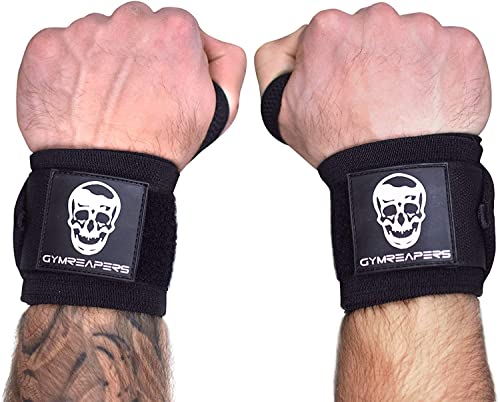

Stiffness is a trade, not a ranking. A rigid wrap locks the joint and lets you press more; it also fights you on anything that needs the wrist to move, and it is genuinely uncomfortable for the first two weeks. A flexible wrap supports without immobilizing. The five below cover both ends of that range, whether you are chasing a bench record, cycling through a workout with kettlebells and pull-ups, or just tired of your wrists aching two days after an overhead session.
At a glance
| Product | Standout feature | Price tier | Link |
|---|---|---|---|
| Gymreapers Weightlifting Wrist Wraps | IPF approved; tension you set anywhere from light to locked | Mid-range | |
| Rip Toned Wrist Wraps | Sold in Stiff or Flex; lifetime replacement warranty | Mid-range | |
| Iron Bull Strength Wrist Wraps | 18 by 3 inch strap; double zig-zag stitched Velcro | Budget | |
| Gymreapers Stiff Heavy Duty Wrist Wraps | Thicker elastic and a reinforced thumb loop; shorter length option | Budget | |
| SBD Stiff Wrist Wraps | Proprietary wide elastic; 8 cm wide; made in Sheffield | Premium | |
How to choose between stiff and flexible wraps
First: wraps are not straps
These get confused constantly and they do opposite jobs. Wrist wraps go around the wrist joint and stop it bending under a load pressed above it. Lifting straps loop around the bar and hold it in your hand when your grip fails on pulls. If your problem is a bar slipping out of your fingers on deadlifts, no wrap on this page helps you. If your problem is your wrist folding under a press, you are in the right place.
What stiff actually means
A stiff wrap uses denser, less elastic material. Wrapped tight, it turns your wrist into something close to a single rigid unit from forearm to palm, so the load travels through bone rather than being held by soft tissue. That is why lifters reach for them on maximal bench, overhead press and jerks.
The costs are real. A stiff wrap is uncomfortable, it restricts blood flow if you leave it cranked between sets, and it is useless for any movement needing wrist articulation. Rip Toned is admirably real here, stating outright that their stiff version starts firm and molds to your wrist over one to two weeks, and that firmness out of the box is the feature rather than a defect. Believe them, and expect a break-in period.
What flexible gets you
A flexible wrap supports while letting the joint move. For CrossFit-style training, kettlebells, higher-rep work, cleans and anything where you rack a bar on your shoulders, that mobility is not a luxury. Flex wraps are also less bulky, which matters if you have smaller wrists and find a stiff wrap swallows your forearm. They will not hold a maximal bench the way a stiff wrap will, and that is the real trade.
Length is the tension dial
Twelve inches gives you a couple of passes: quick on and off, moderate support, good for volume work and warm-ups. Eighteen inches is the standard competition length and lets you build serious compression across several wraps. Longer options exist for maximal work at the cost of time and comfort. Most people are best served by 18 inches, because you can always wrap an 18 inch wrap loosely, but you cannot make a 12 inch wrap longer.
Federation approval, if you compete
The rules are specific and worth checking before you spend. The IPF caps wraps at 8 cm wide and 1 m long. USPA, USAPL and IPL each publish their own list. If competition is anywhere in your plans, buy an approved wrap now rather than discovering on the platform that yours is not legal.
The thumb loop is for wrapping, not for lifting
Its job is to hold the wrap steady while you wind it on. Take it off your thumb before the set. Leaving it on puts a tug on the thumb under load and is a good way to irritate a joint that was not bothering you. A thick, reinforced loop that survives being pulled on is a genuine durability marker, since a torn loop makes a wrap fiddly forever after.
Where the wrap sits
Across the joint, not up the forearm. A wrap centered on your forearm looks the part and does nothing, which is the single most common mistake. Cover the wrist crease, half on the hand and half on the arm, and tighten only for working sets.
Gymreapers Weightlifting Wrist Wraps
The most popular wrap here by a distance, and it sits deliberately in the middle of the stiffness range, which is exactly why it sells. Gymreapers uses a proprietary elastic that will immobilize the wrist when you crank it and support gently when you do not, so one pair covers a heavy bench day and a lighter accessory session. They are IPF approved and true to their 18 inch length, tested by competitive powerlifters and IFBB pros, which matters less as an endorsement than as evidence they meet the federation dimensions. The thumb loops are thicker and reinforced. Gymreapers makes a point of the edges not being rough, which sounds trivial until you have worn a cheap wrap that chewed the side of your hand.
Pros
- Most popular pick here by a wide margin
- IPF approved and true to 18 inch length
- Tension range covers light support through to locked
- Reinforced thumb loops and smooth, non-abrasive edges
- Suits pressing, powerlifting, bodybuilding and cross training
Cons
- A mid-stiffness wrap will not match a dedicated stiff wrap at maximal loads
- 18 inches only in this listing
- Priced above the budget options for similar approval
Best for: one pair that handles everything, from a heavy bench to overhead work, without owning two sets.
Rip Toned Wrist Wraps
This is the only listing here that lets you actually make the choice this article is about: Stiff or Flex, same brand, same price. The Stiff version locks the wrist for heavy bench, overhead press and powerlifting. The Flex version supports while allowing natural movement for CrossFit, kettlebells and bodyweight work, and Rip Toned notes it is the less bulky option for smaller wrists. Both are USPA and USAPL approved. The hook-and-loop closure fits wrists from 5.5 to 9 inches, the pair arrives pre-oriented for left and right, and there is a carry pouch and a lifetime replacement warranty covering Velcro, stitching and material. They are machine washable, which no gym bag has ever regretted.
Pros
- Genuine choice of Stiff or Flex at the same price
- USPA and USAPL approved
- Fits wrists from 5.5 to 9 inches; left and right pre-oriented
- Lifetime replacement warranty, no questions asked
- Machine washable; carry pouch included
- Real about the stiff version’s one to two week break-in
Cons
- Not IPF approved, so check your federation
- Stiff version is genuinely uncomfortable until it molds
- You must decide stiffness at purchase
Best for: anyone who knows which end of the stiffness range they want and wants it assured for life.
Iron Bull Strength Wrist Wraps
Iron Bull publishes the dimension most listings skip: 18 inches long by 3 inches wide. Width is what spreads the load across the joint instead of biting into one line of it, and 3 inches is a proper working width. The construction details are the selling point: top-grade Velcro that does not peel mid-set, double zig-zag stitching where the hook-and-loop meets the elastic, which is precisely where cheap wraps tear first, and a resin logo badge that keeps the weight down. They are USPA and IPL approved. Backing it up is a lifetime warranty against manufacturing defects plus a 30-day satisfaction promise. For the least money here, that is a lot of wrap.
Pros
- Full 18 by 3 inch strap; width stated plainly
- Double zig-zag stitching at the classic failure point
- USPA and IPL approved
- Lifetime warranty plus 30-day satisfaction promise
- Lowest price in the group
Cons
- Not IPF approved
- Stiffness level is not specified, so you cannot choose it
- One length only
Best for: a first proper pair, or a spare set that lives permanently in the gym bag.
Gymreapers Stiff Heavy Duty Wrist Wraps
Gymreapers’ stiff line trades the middle ground of its competition wrap for thicker elastic and more lock. That heavier material is the point: it gives more support and, importantly, holds its tension over months instead of fraying and going slack the way thin stretchy wraps do. The thumb loop is the reinforced type that survives being hauled on. One caveat worth flagging: this listing is inconsistent about length, describing 18 inch wraps in the text while the selected variant is the 12 inch black. Twelve inches is a legitimate choice for quicker wrapping and volume work, but it is not the same tool as an 18, so check the variant you are adding to the basket rather than trusting the headline.
Pros
- Genuinely stiff, thick elastic for heavy pressing
- Holds tension over long-term use rather than going slack
- Reinforced thumb loop built to last the life of the wrap
- Competition-grade build at a budget price
- Shorter length available for faster wrapping
Cons
- Listing contradicts itself on length; verify the variant
- 12 inches gives noticeably less compression than 18
- Stiff material is uncomfortable for high-rep or mobility work
- Least popular of the Gymreapers options here
Best for: heavy bench and overhead pressing where you want the wrist locked and nothing else.
SBD Stiff Wrist Wraps
This is the wrap you see on platforms at serious meets, and the price reflects that rather than any gimmick. SBD develops its own wide elastics specifically for wrist support, manufactures them in Sheffield, and builds left and right specific wraps so both wrists get an identical wind rather than a mirrored compromise. They are IPF approved and compliant with USAPL and USPA at the maximum legal 8 cm width, with lengths up to a meter. The closure uses genuine branded hook and loop. One oddity: although sold as the Stiff wraps, the listing’s own description talks about allowing natural flexion, which reads like copy borrowed from SBD’s flexible model. If you need certainty about which version you are buying, confirm before ordering.
Pros
- IPF approved at the maximum legal 8 cm width
- Proprietary wide elastic developed specifically for wrists
- Left and right specific designs for consistent wrapping
- Made in Great Britain; built for competition longevity
- Lengths available up to 1 m for maximal support
Cons
- Three to four times the price of everything else here
- Listing description contradicts the Stiff name
- Overkill unless you compete or press genuinely heavy
- Least popular listing in this group
Best for: competitive powerlifters who need IPF-legal kit that will outlast several training cycles.
Verdict
Best overall: the Gymreapers Weightlifting Wrist Wraps. The runaway favorite here, and the reason is that a mid-stiffness 18 inch wrap does both jobs: crank it for a heavy single, leave it loose for volume. IPF approved, so it travels to a platform if you ever want it to.
Best value: the Iron Bull Strength Wrist Wraps. Full 18 by 3 inches, reinforced stitching where wraps actually fail, two federation approvals and a lifetime warranty, for the lowest price on the page.
Best premium: the SBD Stiff Wrist Wraps. If you compete under IPF rules, this is the wrap that removes every question about legality and durability at once.
Still deciding between stiff and flexible? The Rip Toned pair is the one that actually offers both, with a lifetime warranty if you pick wrong and wear them out anyway.
Frequently asked questions
Should I buy stiff or flexible wrist wraps?
Match it to what you lift. If your heaviest work is bench, overhead press or jerks and you want the wrist immobilized, buy stiff. If you train across kettlebells, CrossFit, higher reps or anything needing wrist movement, buy flexible; a stiff wrap will fight you. If you do a bit of everything, a mid-stiffness 18 inch wrap set to different tensions covers both better than either specialist.
What is the difference between wrist wraps and lifting straps?
Completely different tools. Wraps support the wrist joint under pressing loads. Straps wrap around the bar to hold it in your hand when your grip gives out on pulls like deadlifts and rows. If your grip is failing, wraps will not help; if your wrist is folding backwards, straps will not help.
Why are my new stiff wraps so uncomfortable?
Because they are supposed to be, at first. Dense material starts firm and molds to the shape of your wrist over roughly one to two weeks of training, after which the fit is conformed and consistent. Rip Toned says this in plain terms in its own listing. Give a stiff wrap two weeks before deciding it was a mistake.
What length should I get?
Eighteen inches for most people. It is the standard competition length, allows several passes for real compression, and can still be wound loosely for lighter work. Twelve inches is quicker on and off and suits volume training but caps how much support you can build. Longer than 18 is for maximal attempts and takes real time to apply.
Are these legal in competition?
Depends on the federation and the wrap. The IPF limits wraps to 8 cm wide and 1 m long; USPA, USAPL and IPL publish separate lists. The Gymreapers competition wrap and the SBD are IPF approved. Rip Toned covers USPA and USAPL; Iron Bull covers USPA and IPL. Check your federation’s current list before a meet rather than relying on a product title.
How tight should I wrap them?
Tight enough that the wrist cannot bend under load, loose enough that your hand does not change color. Only tighten for working sets and undo them between, because leaving a stiff wrap cranked while you rest restricts circulation for no benefit. Position them over the wrist crease, half on the hand and half on the forearm, not up the arm.
This article may contain affiliate links; see our Affiliate Disclosure.