Crawl space air does not stay in the crawl space. It rises through the floor into the rooms above, carrying whatever it picked up down there, which is why a musty smell in a hallway usually starts three feet below it. Fixing that means putting a machine somewhere you can barely reach and trusting it to run unattended for years.


A crawl space dehumidifier is a different machine from the one in a bedroom. It has to fit through a hatch and under joists, resist corrosion in permanently damp air, drain itself without anyone emptying a bucket, defrost when the space gets cold, and restart on its own after a power cut. Capacity ratings, as the buying guide explains, are where most of the confusion lives.
At a glance
| Product | Standout feature | Price tier | Link |
|---|---|---|---|
| Waykar 125 Pint with Pump | Pump lifts water 16.4 ft; metal casing; touchscreen | Premium | |
| ALORAIR 70 Pint with Pump | Highest vertical lift at 19.6 ft; 6-year warranty | Mid-range | |
| Moiswell Defender ME-7 70 Pint | Energy Star certified; lightest here at 40 lb | Budget | |
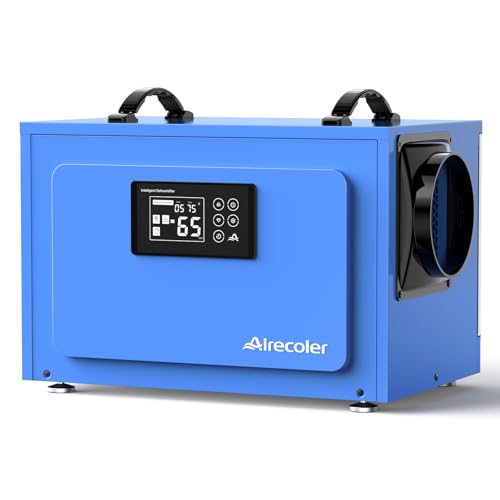
| Airecoler GT-X5 125 Pint | Smallest footprint; suspends between joists | Mid-range | |
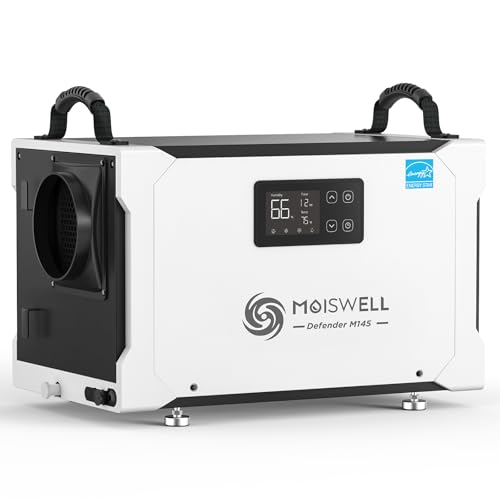
| Moiswell M145 155 Pint | Biggest capacity and airflow; horizontal joist-fit design | Premium | |
How to choose a crawl space dehumidifier
Pint ratings are quoted two ways, and the gap is enormous
This is the most important thing on the page. A dehumidifier advertised at 70 pints is usually quoting extraction at saturation, meaning hot, nearly 100% humid air. The AHAM figure, measured under a standardized and far more realistic condition, is roughly half. Every listing here shows both once you read closely: the ALORAIR and the Moiswell ME-7 both remove 70 pints at saturation and 35 pints under AHAM. The Airecoler does 125 maximum and 60 at AHAM; the Moiswell M145 does 155 maximum and 70 at AHAM.
Compare AHAM to AHAM, or saturation to saturation, and never one against the other. Buying on the big number is how people end up with a unit that underperforms in a cool crawl space.
Measure the hatch before anything else
Capacity is irrelevant if the machine will not physically go in. Crawl spaces are defined by low clearance, and the units here are sized accordingly: the Airecoler is 19.2 by 12.2 by 13.4 inches, the Moiswell M145 is 22.5 by 14 by 14.7 in a deliberately horizontal shape meant to slide between floor joists. Measure the access hatch, the clearance under the joists, and the route from one to the other. Weight matters for the same reason, since you may be dragging it across a dirt floor on your elbows. Forty pounds is manageable; heavier units want two people and a plan.
Pump or gravity: where does the water go?
A dehumidifier makes water continuously and something has to remove it. Gravity drainage is simpler and has nothing to fail: run a hose downhill to a floor drain or a sump. It only works if there is somewhere lower to send it, which in a crawl space frequently there is not.
A built-in pump solves that by pushing water vertically, out to daylight or up to a drain above. The lift figure is the specification to check: the ALORAIR pumps up to 19.6 feet, the Waykar up to 16.4 feet, which it notes is above the usual 10 to 13 feet. Machines offering both, gravity by default and the pump when needed, give you the most installation options. If a pump is your only drainage route, remember it is a moving part in a place you would rather not revisit.
Auto defrost is not optional down there
Crawl spaces get cold, and a dehumidifier’s coils ice up in cold air. Once frosted, it stops removing moisture and just consumes power. Automatic defrost cycles the machine to clear the ice and resume, and every unit here has it. Along with it, look for automatic restart, sometimes called memory start: after a power cut the machine should come back on with its previous settings rather than sitting dead until someone crawls in to check. For an unattended install, that single feature is worth more than a few pints of capacity.
Build quality, because the air is the enemy
These machines live in the conditions that destroy machines. Corrosion-resistant and metal casings hold up where plastic and thin aluminum do not, and rotary compressors are more efficient and more reliable than older piston designs. Warranties run long here, from five years up to six with the first two in full coverage. In a location this awkward to service, warranty length is a genuine feature.
Set it and leave it
A humidistat that cycles the unit on and off to hold a target level, rather than running flat out forever, saves both power and compressor life. Timers, continuous mode, and auto drain serve the same end. Optional remotes exist on several models but are typically sold separately, and a hanging kit reduces vibration noise through the floor.
Waykar 125 Pint Crawl Space Dehumidifier with Pump
The best seller of this group, and the most thoroughly built machine here. It extracts up to 125 pints a day at 95 degrees and 90% humidity, with up to 177 CFM circulation, covering spaces up to 6,500 sq ft. The compressor is a rotary design, which Waykar contrasts directly with the piston compressors prone to failure, claiming 5 to 10% better energy efficiency and 15 to 20% lower power draw. Drainage is covered twice over: a 16.4 ft pump hose for vertical lift, above the 10 to 13 ft typical of rivals, and a 6.6 ft gravity hose for downhill runs. The casing is high-strength metal resisting corrosion, dents, and impacts. Adjustable feet cut noise and vibration, and hooks and handles make it movable. Backed by five years.
- Pros: Strong pump lift at 16.4 ft plus a separate gravity hose; heavy metal casing built for corrosive, damp air; efficient rotary compressor; 177 CFM across up to 6,500 sq ft; touchscreen panel; adjustable feet reduce noise; five-year coverage and TUV compliance.
- Cons: Among the most expensive here; the remote control is sold separately, which is awkward for a machine in a crawl space; no published dimensions, so measure your hatch carefully before ordering; no AHAM figure quoted alongside the 125-pint maximum.
Best for: Large or badly damp crawl spaces where build quality and drainage flexibility matter most.
ALORAIR 70 Pint Crawl Space Dehumidifier with Pump
The professional’s pick, and the most accurate listing in the group: 70 pints at saturation, 35 under AHAM, stated plainly rather than buried. It uses an R32 system across areas up to 1,000 sq ft, with a corrosion-resistant casing built to shrug off dust and moisture year-round. Its pump is the strongest here, discharging vertically up to 19.6 feet, with a gravity hose included for sites with a floor drain. The set-and-forget features are the real argument: automatic defrost, GPP mode, pump mode, and automatic restart retaining previous settings after an outage. The warranty runs six years with the first two in full coverage, and the units are ETL-listed.
- Pros: Highest vertical pump lift here at 19.6 ft, opening up awkward installs; states both saturation and AHAM ratings openly; R32 system; corrosion-resistant casing for demanding environments; automatic defrost and automatic restart with settings retained; longest warranty at six years, first two in full; ETL-listed; hanging and leveling kits available.
- Cons: 1,000 sq ft is the smallest coverage in this comparison; 35 pints AHAM is modest for a badly wet space; the useful accessories, remote and hanging kit, all cost extra; priced above the similarly rated Moiswell ME-7.
Best for: Smaller crawl spaces with no floor drain, where water has to be pumped a long way up.
Moiswell Defender ME-7 70 Pint Commercial Dehumidifier
The sensible entry point, and the only Energy Star certified unit at this capacity here. It removes up to 70 pints at saturation and 35 under AHAM, matching the ALORAIR on paper for less money, and the Energy Star certification matters more than usual on a machine designed to run continuously for years. It weighs only 40 pounds and has two handles, which anyone who has moved equipment through a crawl space hatch will appreciate more than any spec. Construction is durable metal with an upgraded refrigeration system using quality copper components. Drainage is gravity only, feeding condensate to an external point without intervention, and the large display shows whether it is dehumidifying, defrosting, or pumping at a glance.
- Pros: Least expensive here; Energy Star certified, which pays back on a unit running year-round; identical 70-pint saturation and 35-pint AHAM ratings to the pricier ALORAIR; lightest at 40 pounds with two lifting handles; durable metal build with copper refrigeration components; clear, informative display; automatic defrost.
- Cons: Gravity drainage only, so it needs somewhere lower to send water; no built-in pump, ruling out many crawl spaces outright; modest AHAM capacity; no published dimensions.
Best for: Crawl spaces with an existing floor drain or sump, where efficiency and easy handling matter more than pumping.
Airecoler GT-X5 125 Pint Commercial Dehumidifier
The one that fits where others will not. At 19.2 by 12.2 by 13.4 inches it has the smallest footprint here, and Airecoler is explicit that it can stand free, sit on a surface, or be suspended between floor joists, keeping the machine off a damp floor. It extracts up to 125 pints daily at maximum and 60 at AHAM, covering up to 6,000 sq ft, so the real capacity sits between the 70-pint units and the largest machine here. An R32 system keeps consumption down, and a 24-hour timer trims it further. Everything is automated: auto on/off to a preset humidity, auto drain, auto defrost, continuous mode, and auto restart. Cover runs five years, two on the whole machine and three more on the dehumidification system.
- Pros: Smallest dimensions here, genuinely suited to low-clearance crawl spaces; can be suspended between joists; 60 pints at AHAM is a strong real-world figure; up to 6,000 sq ft; efficient R32 system with a 24-hour timer; full automation; five-year staged coverage.
- Cons: No built-in pump, so gravity drainage only; suspension hardware is not described as included; the headline 125-pint figure is a maximum, with 60 the real working number; a lesser-known brand than ALORAIR or Waykar.
Best for: Tight, low-clearance crawl spaces where the machine must hang between joists.
Moiswell M145 155 Pint Commercial Dehumidifier
The heavyweight, and the one designed around the crawl space rather than adapted to it. The horizontal body measures 22.5 by 14 by 14.7 inches and is shaped to sit between floor joists, mounted on the floor or overhead, which is exactly the problem a vertical dehumidifier cannot solve. It moves 265 CFM and removes up to 155 pints a day at maximum, 70 at AHAM, the highest genuine capacity in this comparison. It is Energy Star certified despite the output. Choose a humidity level and it cycles itself, with a 24-hour timer, auto drain, auto defrost, and auto restart. The warranty is five years limited, and Moiswell is candid that the brand is newer than its team’s experience.
- Pros: Highest real capacity here at 70 pints AHAM and 155 maximum; strongest airflow at 265 CFM; horizontal shape purpose-built to fit between joists, floor or overhead; Energy Star certified despite the output; full automation with humidity cycling, timer, defrost, and restart; five-year limited warranty.
- Cons: The most expensive machine in this comparison; the largest body, so the hatch and route need checking; gravity drain hose only, with no pump; a newer brand with a shorter track record.
Best for: Large, persistently wet crawl spaces that need serious capacity in a joist-friendly shape.
Verdict
Best Overall: Waykar 125 Pint with Pump. The best seller of this group, and the most complete answer to the problem. It is the only machine here pairing a strong 16.4 ft pump with a gravity hose, so it installs almost anywhere regardless of whether a drain exists, and the metal casing and rotary compressor are built for air that eats equipment. It handles the widest range of crawl spaces here.
Best Value: Moiswell Defender ME-7 70 Pint. The cheapest unit here matches the pricier ALORAIR’s ratings, adds Energy Star certification that pays back on a machine running permanently, and weighs only 40 pounds with two handles. If your crawl space has a floor drain, it is hard to justify spending more.
Best Premium: Moiswell M145 155 Pint. The highest true capacity in the group at 70 pints AHAM, the strongest airflow, and a horizontal body designed to slot between joists. For a large crawl space that stays wet, this is the machine that keeps up.
Two specific installs: choose the ALORAIR 70 Pint when water must be pumped as far as 19.6 feet upward, and the Airecoler GT-X5 when clearance is so tight the unit has to hang between the joists.
Frequently asked questions
Why do the pint ratings differ so much between listings?
Because they are measured under different conditions. A saturation rating uses hot, extremely humid air and produces the biggest number, which is why it goes on the box. The AHAM rating uses a standardized, cooler, more realistic condition and typically comes out around half. A 70-pint machine is often a 35-pint machine in practice. Always compare the same rating type across products.
Do I need a pump?
Only if there is nowhere lower to send the water. Gravity drainage is simpler, silent, and cannot fail, so it is the better choice when a floor drain or sump sits below the unit. Crawl spaces often have neither, and then a pump is essential, lifting condensate up to 19.6 feet on the ALORAIR or 16.4 on the Waykar.
What humidity level should I set?
Somewhere around 50 to 55% relative humidity is the usual target. That is dry enough to discourage mold, dust mites, and rot, without the machine running constantly chasing a level it cannot hold. Set the humidistat and let it cycle rather than running continuous mode indefinitely, which wears the compressor and wastes power.
Will it work in a cold crawl space?
Yes, provided it has automatic defrost, and all the units here do. Compressor dehumidifiers ice up in cold air and stop removing moisture until the frost clears; the defrost cycle handles that automatically. In genuinely freezing conditions, output falls regardless, which is another reason not to size a unit on its saturation rating.
Should the crawl space be sealed first?
It helps enormously. A dehumidifier fighting outdoor air through open vents and bare earth runs forever and never wins. Sealing vents and covering the ground with a vapor barrier cuts the moisture load dramatically, and the machine then only has to handle what remains.
This article may contain affiliate links; see our Affiliate Disclosure.