The campsite picnic table, the tailgate, the balcony with room for exactly one thing: these are the places a full-size grill will never go. A tabletop propane grill folds its legs, locks its lid, rides in the trunk, and is searing burgers ten minutes after you set it down. No charcoal to haul, no coals to babysit, no hour of waiting while everyone eyes the cooler.


The good ones get four things right: enough heat to actually sear, a cooking area that matches your crowd, a lid and legs that lock down for transport, and cleanup you can do at a campsite. Whether you are grilling for two on a small deck, feeding a tailgate, or throwing a grill in the van for the season, these five cover the range from a bare-bones single burner to a two-burner with swappable cooktops.
At a glance
| Product | Standout feature | Price tier | Link |
|---|---|---|---|
| Cuisinart Chef’s Style 2-Burner Grill | Best seller, 20,000 BTU, two heat zones, thermometer | Mid-range | |
| Charbroil Portable 1-Burner Grill | Lowest cost, porcelain-coated grates, 190 sq in | Budget | |
| Megamaster 1-Burner Portable Grill | 360 sq in from one burner, locking lid, foldable legs | Budget | |
| Royal Gourmet Stainless Tabletop Grill | Stainless build, warming rack, runs on a 1 lb cylinder | Mid-range | |
| Coleman RoadTrip 225 2-Burner Grill | Swappable cooktops, matchless ignition, two burners | Premium | |
How to choose a portable tabletop gas grill
One burner or two
This is the decision that shapes everything else. A single burner is lighter, cheaper, and simpler, and it grills a batch of burgers perfectly well when everything cooks at the same temperature. Two burners with independent knobs give you heat zones: sear over the hot side, then slide food to the cooler side to finish through without burning, or keep the first batch warm while the second cooks. If you grill thick cuts, chicken, or anything that needs to cook through rather than fast, two zones are worth the extra money and weight.
BTU and what it actually means
BTU measures fuel burned, not how well a grill cooks, so treat it as a rough guide rather than a score. What matters is BTU relative to the cooking area: around 10,000 to 11,000 BTU over a compact surface gets genuinely hot, while 20,000 BTU across two burners gives you both reach and control. A well-built firebox that holds heat and grates that distribute it evenly beat a big number on a leaky box every time. Look for even heat and a lid that seals, not just the headline figure.
Cooking area versus packed size
Count what you cook. Roughly 190 to 225 square inches handles a few burgers and suits two to four people, which covers most camping and balcony use. Around 250 to 285 square inches feeds a small group and gives room to work, and some designs add a warming rack that stacks extra space above the grate without widening the footprint. Then check the packed dimensions and weight, because a grill you resent carrying is a grill that stays home. Around 22 to 25 pounds is the sweet spot for something one person can move easily.
Fuel: small cylinders and big tanks
Most tabletop grills are designed around a 1-pound disposable propane cylinder, which is compact and perfect for a weekend, and almost always sold separately. If you grill often, a 1-pound cylinder gets expensive and wasteful, so check whether the grill can accept an adapter hose to a standard refillable tank for backyard use. Some larger tabletop models come with a regulator and hose for a full-size tank instead. Match the fuel plan to how you actually cook, and always bring a spare cylinder.
Grates and cleanup
Stainless steel grates handle high heat, resist rust, and take a scrub, which suits searing and long service. Porcelain-coated grates are easier to clean and resist rust well, as long as you avoid gouging the coating with metal tools. Either way, the piece that decides whether cleanup is a chore is the grease tray: a large, removable tray or water pan that slides out and empties without dismantling the grill is what you want, especially when the only sink is a campground spigot.
Transport and the details that matter
A locking or latching lid is the difference between a grill and a mess in your trunk. Folding legs, a carry handle, and a body that stays cool enough to move round out the essentials. Push-button or twist-start ignition beats hunting for matches in the wind. A lid thermometer is genuinely useful for anything cooked with the lid down, and heat-resistant handles are one of those small things you appreciate every single time.
Cuisinart Chef’s Style 2-Burner Grill
The best seller here, and the one that feels most like a real grill that happens to fold. Two stainless burners deliver 10,000 BTU each for 20,000 total, and because each has its own control knob you get proper custom heat zones instead of one blast setting. Stainless grates spread heat evenly and give you the confidence to cook large cuts or delicate items, and an integrated thermometer plus adjustable knobs mean you are cooking to a temperature rather than guessing. Twist-start ignition fires it reliably without matches, setup takes under ten minutes with no tools, and at 22 pounds with folding legs, a locking lid, and a carry handle it moves easily between deck, trunk, and campsite.
Pros
- Two independent burners and 20,000 BTU for real heat zones
- Stainless grates deliver even heat for large or delicate foods
- Integrated thermometer and reliable twist-start ignition
- 22 lb with folding legs, locking lid, and handle
Cons
- Costs more than the single-burner options
- Bulkier to pack than a bare-bones grill
Best for: most buyers. Camping, tailgating, and small decks where two heat zones and a thermometer matter.
Charbroil Portable 1-Burner Grill
Sometimes the honest answer is the cheap one that works. This single-burner Charbroil keeps things deliberately simple: liquid propane, 190 square inches of cooking space, and porcelain-coated grates that resist rust and wipe clean without ceremony. Steel construction with a high-temperature finish is built to shrug off the knocks and weather that come with being tossed in a trunk. Assembly is minimal, there is nothing to learn, and it is the least you can spend and still be grilling properly rather than fussing with charcoal. If you grill a handful of times a year, or want a spare that lives in the camper, it is hard to argue with.
Pros
- Lowest price here for a genuine propane grill
- Porcelain-coated grates resist rust and clean easily
- Durable steel body with high-temperature finish
- Minimal assembly, nothing to fuss over
Cons
- One burner means a single heat zone
- Smallest cooking area and a short parts warranty
Best for: occasional grillers and anyone wanting a cheap, no-nonsense grill for the camper or trunk.
Megamaster 1-Burner Portable Grill
The Megamaster is the surprise of the group: a single-burner grill with an unusually generous 360 square inches of cooking space, which is more room than several two-burner rivals. An 11,000 BTU stainless burner and a porcelain steel firebox get it hot quickly and hold that heat, so it cooks a proper batch rather than a token few patties. The heat-resistant steel frame is built for wear, and foldable legs plus a locking lid make it easy to carry and store without compromising stability once it is set down. The trade for that space and price is a single heat zone, so everything on the surface cooks at one temperature.
Pros
- Large 360 sq in surface for a single-burner grill
- 11,000 BTU stainless burner heats fast
- Locking lid and foldable legs for easy transport
- Sturdy steel frame with heat-resistant finish
Cons
- One burner, so no two-zone cooking
- Larger surface takes more fuel to heat fully
Best for: feeding a group on a budget when you want maximum grate space for the money.
Royal Gourmet Stainless Tabletop Grill
This is the tidy, well-finished option for a deck or a camping table. A U-shaped stainless tubular burner puts out 10,000 BTU with fast, even heat distribution that sears properly, and the 285 square inches of total space splits smartly: 214 square inches of stainless cooking grate plus a 71-square-inch chrome-coated warming rack, so you can hold finished food above while the next batch cooks. Folding legs and a latching hood with a compact handle make it genuinely portable, and assembly is a few steps. It runs on a 1-pound propane tank via the included regulator, tank sold separately, and a large removable stainless grease tray means you can dump residue as you go.
Pros
- Stainless build and grate for even, high heat
- Warming rack adds space without a bigger footprint
- Folding legs and latching hood for easy carrying
- Large removable grease tray for quick cleanup
Cons
- Single burner and one heat zone
- Built around 1 lb cylinders, which add up with frequent use
Best for: decks, patios, and tailgating where a warming rack and stainless finish are worth having.
Coleman RoadTrip 225 2-Burner Grill
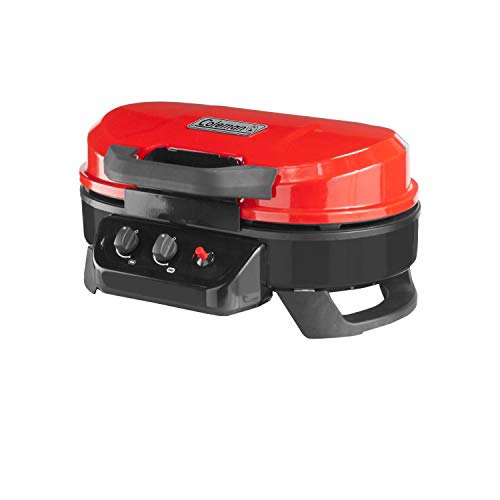
Coleman has been building camp cooking gear for a very long time, and this grill shows it. Two adjustable burners across 225 square inches give up to 11,000 BTU with precise temperature control, so you can run a hot side and a gentle side on a compact surface. Instastart push-button ignition lights it without matches, which anyone who has knelt in the wind with a lighter will appreciate. The removable water pan catches grease and rinses out easily. Its real party trick is the interchangeable cooktops: swap the grate for a griddle or a stove grate (each sold separately) and one packed unit handles burgers, pancakes, and a pot of coffee. It uses a 1-pound cylinder, sold separately.
Pros
- Two adjustable burners for temperature control
- Swappable griddle and stove cooktops expand the menu
- Matchless push-button ignition
- Removable water pan makes cleanup simple
Cons
- Extra cooktops cost more on top
- Propane cylinder not included
Best for: campers and road trippers who want one unit to grill, griddle, and boil.
The verdict
Best overall: the Cuisinart Chef’s Style 2-burner is the best seller and the most complete portable grill here, with 20,000 BTU across two controllable zones, stainless grates, a thermometer, and a 22-pound package that sets up in minutes.
Best value: the Megamaster single-burner gives you 360 square inches, more grate space than most two-burner rivals, for a budget price. The Charbroil is the pick if you want to spend the absolute minimum and still grill on gas.
Best premium: the Coleman RoadTrip 225 earns it with versatility, two adjustable burners and interchangeable griddle and stove tops that turn one packed grill into a whole camp kitchen.
FAQ
Do I need one burner or two?
One burner is lighter, cheaper, and fine when everything cooks at the same heat. Two burners give you a hot searing zone and a cooler finishing zone, which matters for thick cuts, chicken, and keeping batches warm.
What propane does a tabletop grill use?
Most are built around a 1-pound disposable cylinder, almost always sold separately. If you grill often, check whether an adapter hose lets you run a standard refillable tank, which is cheaper and less wasteful.
How much cooking area do I need?
Around 190 to 225 square inches suits two to four people, which covers most camping and balcony grilling. Around 285 to 360 handles a small group, and a warming rack adds space without widening the grill.
Stainless or porcelain-coated grates?
Stainless handles high heat, resists rust, and takes a hard scrub, which suits searing. Porcelain-coated is easier to clean and rust-resistant, but avoid metal tools that can chip the coating.
Can I use one on a balcony or a wooden table?
Set it on a stable, heat-resistant surface with clearance around and above, and check your building or campground rules, as many restrict propane on balconies. Grills with a bottom heat shield and heat-resistant handles are safer on a table.
How long does a 1-pound cylinder last?
Roughly a couple of hours of grilling, depending on burner size and how high you run it. Bigger surfaces and higher settings burn through faster, so bring a spare for a full day out.
This article may contain affiliate links; see our Affiliate Disclosure.