Your phone hits ten percent on a platform somewhere, and the cable is, of course, in the other bag. A power bank with wireless output solves that with a snap: slap it on the back of the phone and walk while it charges, no fumbling, no dangling cord. The catch is that wireless output ranges from genuinely fast to barely a trickle, and the size that fits your pocket may not hold the power you need.



A great wireless power bank balances output speed, capacity, and pocketability, and backs the wireless pad with a fast wired port for when you want maximum speed. This lineup spans an ultra-slim pocket model, top-selling magnetic chargers, and high-capacity banks with built-in cables. Whether you top up on a commute, travel for days between outlets, or juggle several devices at once, one of these fits.
At a glance
| Product | Standout features | Price tier | Link |
|---|---|---|---|
| TORRAS MiniMag | Best seller, fast 25W wireless, 45W wired, slim magnetic | Premium | |
| Ouotoo Ultra-Thin | Pocket-sized and light, 15W wireless, LED display | Budget | |
| Baseus Picogo AM52 | 25W wireless, built-in 45W cable, strong heat control | Premium | |
| YHO 7-in-1 | Huge capacity, three built-in cables, charges many devices | Mid-range | |
| MAUTONG 6-in-1 | Built-in cables plus a foldable wall plug, LED display | Mid-range | |
How to choose a wireless power bank
Wireless output is convenient, but the specs behind it decide whether it is genuinely useful or just a novelty.
Wireless speed: 15W versus 25W
Older Qi wireless output tops out around 5W to 15W, which is fine for a slow top-up but slow if you are in a hurry. Newer Qi2 and Qi2.2 magnetic charging pushes up to 25W on compatible phones, which makes a real difference on a short break. Check your phone as well as the bank, since the fastest speeds require both sides to support the newer standard, and many phones cap at 15W regardless.
Magnetic snap versus flat pad
Magnetic banks align themselves to the coil and stay stuck to the back of the phone, so you can keep using it while it charges. That alignment also improves efficiency, since a misaligned coil wastes energy as heat. The catch is that magnetic snap-on charging is designed around recent iPhones and MagSafe-style cases; most Android phones will charge from these banks by cable instead, or sit on a flat pad without the magnetic hold.
Capacity versus size
Capacity, measured in mAh, is a trade against bulk. A 5,000mAh bank is barely thicker than a phone case and gives you most of one charge, perfect for a night out. A 10,000mAh bank is the sweet spot for a full day with a couple of top-ups. Beyond 20,000mAh you get days of power and multiple device charges, but you carry real weight. Airlines generally allow these in carry-on luggage, so check the limit if you fly often.
Wired output, cables, and heat
Wireless charging is always less efficient than a cable, so a good bank also offers a fast wired port, ideally 20W or higher, for when speed matters or you need to charge a tablet or laptop. Built-in cables mean nothing to forget, and a foldable wall plug lets the bank recharge itself directly from an outlet. Finally, look for real heat management, since a hot bank charges slower and ages faster.
Why you never get the full capacity
A 10,000mAh bank does not deliver 10,000mAh to your phone, and that is physics rather than deceit. Energy is lost converting voltage, and more is lost again as heat, so a realistic wired figure is somewhere around two-thirds of the printed number. Go wireless and the loss grows further, since the coils give up a good share of the energy as warmth. That is why a 5,000mAh bank charging wirelessly may give you rather less than the full top-up you imagined, while the same bank over a cable does better. None of this makes wireless a bad choice, because convenience has real value, but set your expectations from the wired figure and take wireless as the easy option rather than the efficient one.
Recharge speed and how you refill it
People obsess over output and forget input, which is how fast the bank itself refills. A bank with slow input can take most of a day to recharge, which is miserable if you need it again the next morning. Look for a decent input wattage: the strongest model here accepts 30W and refills in roughly an hour and a half, while cheaper banks trickle in far more slowly. Consider how you will refill it, too. Most take USB-C, so you need a wall charger capable of the wattage, and a weak old adapter will bottleneck the whole thing. The built-in wall plug on one model here removes that problem entirely by letting the bank plug straight into an outlet, which also means one less brick in your bag.
Living with a wireless power bank
A few practical points make these far more useful day to day. Thick or metal cases, and anything with a card holder or a pop socket in the way, weaken or block the magnetic hold and the charging itself, so a MagSafe-compatible case of sensible thickness is worth having if you plan to snap a bank on regularly. Keep the pairing clean, since a coin or key trapped between phone and bank gets hot; the better banks detect foreign objects and shut off, which is a feature worth having. Expect warmth in normal use and avoid charging under a pillow, in a tight pocket, or in direct sun, because heat is the enemy of both speed and battery lifespan. For flying, keep the bank in your carry-on and never in checked luggage, as airlines require it and set a capacity limit, which is why the 10,000mAh models are described as flight friendly while very large banks can be a problem. For longevity, avoid running the bank flat to zero constantly and try not to leave it fully charged in a hot car, and if you are pressed for time before heading out, plug in with the cable rather than the magnet, since wired is always the faster way to move power.
TORRAS MiniMag
The TORRAS MiniMag is the best seller of this group, and its spec sheet explains why. Qi2.2 magnetic charging delivers up to 25W wirelessly, near the top of what phones accept, and the wired side is unusually strong with 45W output and 30W input, so the bank itself refills in roughly an hour and a half. Its 10,000mAh capacity covers a full day with multiple top-ups, and the ultra-slim magnetic body snaps on and disappears into a pocket. It is certified and warranty backed, and it is the most complete choice here.
Pros
- Best seller with fast 25W magnetic wireless output
- Strong 45W wired output for tablets and more
- Fast 30W input refills the bank quickly
- Slim, pocketable 10,000mAh design
Cons
- Priced at the premium end
- Top wireless speed needs a compatible recent phone
Best for: anyone who wants the fastest, most complete magnetic power bank.
Ouotoo Ultra-Thin
The Ouotoo is the one you actually carry, because at roughly half an inch thick and about 128 grams you forget it is there. Its 5,000mAh capacity is the sensible middle: enough to turn a low battery warning into a comfortable evening, without the brick weight. It offers 15W magnetic wireless charging plus a 20W USB-C port, and it can charge two devices at once, phone on the magnet and earbuds on the cable. Reinforced magnets hold firmly through most cases, and safety features include foreign object detection. It is superb value for everyday carry.
Pros
- Extremely thin and light for pocket carry
- 15W wireless plus a 20W USB-C port
- Charges two devices at once
- Strong magnetic hold and safety protections
Cons
- Smaller capacity means fewer full charges
- Wireless output caps at 15W, not 25W
Best for: everyday carry, nights out, and anyone who hates bulk.
Baseus Picogo AM52
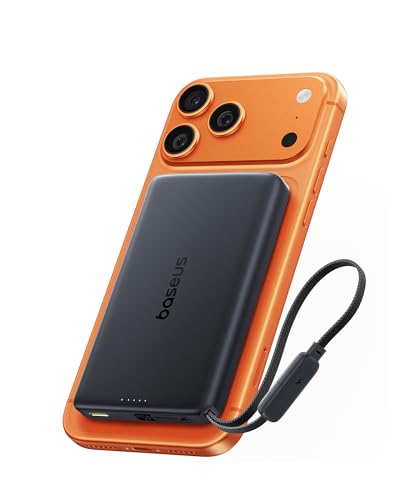
The Baseus Picogo pairs Qi2.2 certified 25W wireless charging with a clever built-in USB-C cable that delivers up to 45W and then doubles as a carry strap. That means no separate cable to lose and enough wired power for a tablet or a light laptop. Baseus puts real work into heat, with a temperature control chip, a graphene inner layer, and an aluminum shell that keeps the surface notably cooler than typical banks, which protects both speed and battery life. At 10,000mAh in a slim alloy body, it is a polished, flight-friendly companion.
Pros
- Qi2.2 certified 25W wireless charging
- Built-in 45W cable that doubles as a strap
- Excellent heat management keeps it cool
- Slim alloy build and travel-friendly capacity
Cons
- Premium price and iPhone-focused magnetic design
- Wired charging takes priority unless you enable dual mode
Best for: travelers who want fast charging with no cable to carry.
YHO 7-in-1
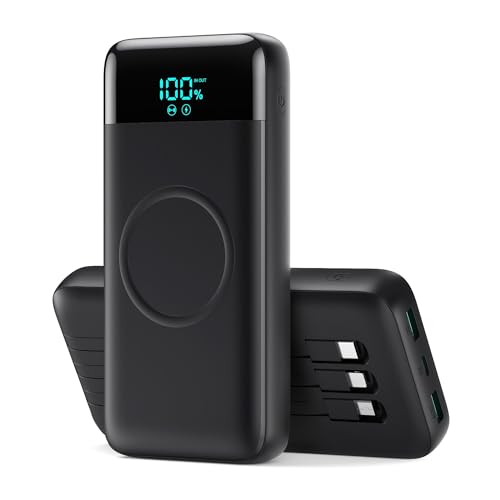
When you need to power a whole group or a long trip, the YHO brings serious reserves. Its 40,800mAh battery recharges phones many times over, and with three built-in cables, three ports, and a wireless pad it can serve up to seven devices at once. That makes it a natural for road trips, camping, or a family with mismatched connectors, since you carry no extra cables. It adds 15W wireless output and 25W wired fast charging. The weight, around 475 grams, is the real trade for that much capacity.
Pros
- Enormous capacity for days away from outlets
- Three built-in cables and multiple ports
- Charges up to seven devices at once
- 15W wireless plus 25W wired fast charging
Cons
- Heavy and bulky compared to slim banks
- Flat pad rather than a magnetic snap-on hold
Best for: trips, groups, and multi-device users who need maximum capacity.
MAUTONG 6-in-1
The MAUTONG is the do-everything traveler, folding six functions into one 10,000mAh body: magnetic wireless charging, a built-in USB-C cable, a built-in Lightning cable, a foldable AC wall plug, and both USB-C and USB-A ports. The wall plug is the standout, letting the bank recharge straight from an outlet and act as a wall charger for your phone, so you can leave the adapter at home. It handles up to five devices at once, shows exact battery percentage on an LED display, and fits easily in a pocket or bag.
Pros
- Foldable wall plug doubles as a charger, no adapter needed
- Built-in USB-C and Lightning cables plus two ports
- Charges up to five devices simultaneously
- Clear LED percentage display
Cons
- 15W wireless rather than the faster 25W
- Thicker than the slimmest magnetic banks
Best for: travelers who want to carry one device instead of four.
The verdict
Best overall: the TORRAS MiniMag. As the best seller it leads on the numbers that count, 25W magnetic wireless output, 45W wired power, and fast 30W recharging, all in a slim 10,000mAh body. For most people it is the complete answer.
Best value: the Ouotoo Ultra-Thin, a genuinely pocketable magnetic bank with 15W wireless and a 20W port for a fraction of the premium price.
Best premium: the Baseus Picogo AM52, which matches the fast 25W wireless charging with a built-in 45W cable and the best heat control here.
Frequently asked questions
How fast is wireless charging from a power bank? Most deliver 15W, while newer Qi2.2 magnetic banks reach up to 25W on compatible phones. Both the bank and the phone must support the faster standard, and many phones cap at 15W.
Do magnetic power banks work with Android phones? The magnetic snap-on design is built around recent iPhones and MagSafe-style cases. Most Android phones charge from these banks by cable instead, or wirelessly at slower speeds without the magnetic hold.
What capacity do I need? Around 5,000mAh gives most of one phone charge in a pocketable size, 10,000mAh covers a full day with top-ups, and 20,000mAh or more suits trips and multiple devices at the cost of weight.
Can I take these on a plane? Power banks generally travel in carry-on luggage, not checked bags, and airlines set a capacity limit. The 10,000mAh models here are described as flight friendly; check your airline for larger banks.
Why does wireless charging feel slower and warmer? Wireless transfer is less efficient than a cable, and the lost energy becomes heat. Good magnetic alignment and proper heat management reduce it, but a wired port is still the fastest way to charge.
Will it work through my phone case? Thin MagSafe-compatible cases are fine, and most makers suggest a limit of around 3mm. Thick cases, metal, or a card holder in the way weaken the magnetic hold and slow or block charging.
Why do I not get the full advertised capacity? Energy is lost in voltage conversion and as heat, so expect roughly two-thirds of the printed figure over a cable and less again wirelessly. That is normal for every power bank, not a defect.
How long does the bank itself take to recharge? It depends on its input rating and your wall charger. The fastest here accepts 30W and refills in about an hour and a half, while budget banks take considerably longer, especially from a weak adapter.
Can these charge a laptop or tablet? The models with 45W wired output can handle a tablet or a light laptop over USB-C. The wireless pad is for phones and earbuds only, so use the cable for anything larger.
This article may contain affiliate links; see our Affiliate Disclosure.