Hotel Wi-Fi asks you to accept two things: that a captive portal will let each of your devices on individually, one code at a time, and that a network shared with three hundred strangers is somewhere you should do your banking. A travel router quietly refuses both. It logs in once, then hands you your own private network inside theirs.




Four of the picks below do that job: they connect to the hotel network once and rebroadcast it as your own encrypted one, with every device already remembering the password. The fifth ignores hotel Wi-Fi entirely and brings its own 5G. This guide suits business travelers, families with a pile of devices, and anyone who has fought a captive portal at midnight with a laptop, a phone, and a tablet that all want separate codes.
At a glance
| Product | Standout feature | Price tier | Link |
|---|---|---|---|
| GL.iNet Beryl AX (GL-MT3000) | Wi-Fi 6, 2.5G WAN port, VPN client and server at once, OpenWrt | Mid-range | |
| TP-Link Roam 6 AX1500 | Wi-Fi 6 in a pocket, runs off a power bank over USB-C | Budget | |
| GL.iNet Opal (GL-SFT1200) | Cheapest route to OpenVPN and WireGuard; 145g; three gigabit ports | Budget | |
| GL.iNet Slate 7 (GL-BE3600) | Wi-Fi 7 with a touchscreen; QR scan to join, VPN toggle on the device | Premium | |
| NETGEAR Nighthawk M7 | Skips hotel Wi-Fi: 5G with eSIM in 140+ countries, 10-hour battery | Premium | |
How to choose a travel router
What it actually fixes
Three things, and the first is the one people buy it for by accident. Log in once: the router deals with the captive portal, and every device you own connects to a network name and password they already know, including the ones with no browser like a streaming stick or a games console. Privacy: your devices talk to the router, not to the hotel network, so the strangers on the other side of the lobby see one device instead of five. And control: your own network means your own rules, your own VPN, and printers or drives that can see each other.
Hotspot mode is the mode you want
The mode names vary but the ideas do not. Hotspot or repeater mode joins an existing wireless network, which is the hotel case. Router mode takes a wired Ethernet connection, which is the hotel with a socket behind the desk, or a phone tethered over USB. AP mode adds Wi-Fi to a wired connection. Any router here does all of them, usually with a switch or a menu. What matters is that the box handles a captive portal cleanly, which GL.iNet calls out explicitly for public and hotel Wi-Fi.
VPN, and why it belongs on the router
Running a VPN on every device separately is fiddly and impossible on half of them. Running it on the router means everything behind it is covered, including the ones that cannot run a VPN client at all. OpenVPN and WireGuard come pre-installed on all three GL.iNet picks and work with more than thirty providers, and TP-Link’s Roam 7 offers both too. WireGuard is the faster of the two by a distance, and the speed figures matter: the Beryl 7 quotes up to 1100 Mbps on WireGuard, while smaller units are far slower, because encryption is real work for a small processor. You still need your own VPN subscription.
How much speed do you need
Less than the numbers suggest, because your bottleneck is the hotel, not the router. A Wi-Fi 6 AX1500 unit at 1201 Mbps on 5GHz is already far beyond what any hotel connection will deliver to your room. Wi-Fi 7 and 2.5G Ethernet ports are worth having for one scenario in particular: using the same router at home, in an RV, or anywhere with genuinely fast internet, where those ports stop being decoration. Buy the speed for your second use case, not your first.
Power and packing
The best travel routers run off USB-C, so a power bank or your laptop charger runs them and there is one less brick in the bag. The Roam 6 takes any 5V/3A PD source. Look at the plug situation too if you travel internationally: GL.iNet ships US, UK, and EU plugs with the Beryl AX, and adds AU with the Wi-Fi 7 models, which is one adapter you do not have to remember.
Security beyond the VPN
Two things worth checking. WPA3 support, which GL.iNet highlights, is the current standard for protecting your own network’s password against brute forcing. And who maintains the firmware, since a router is a computer facing a hostile network. GL.iNet’s units run OpenWrt, which is open source, widely reviewed, and supports thousands of plug-ins if you want them. TP-Link points to its signature on the US Cybersecurity and Infrastructure Security Agency’s Secure-by-Design pledge. Either is a better answer than an anonymous box with firmware nobody updates.
GL.iNet Beryl AX (GL-MT3000)
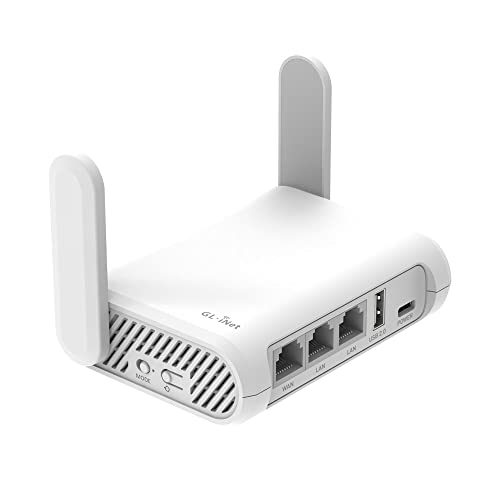
The best-selling travel router here, and the one that reads like it was designed by people who travel. Dual-band Wi-Fi 6 runs 574Mbps on 2.4GHz and 2402Mbps on 5GHz, with a 2.5G multi-gigabit WAN port and a gigabit LAN, so it is not embarrassed when you plug it into something fast. The VPN implementation is the headline: OpenVPN and WireGuard pre-installed for more than thirty providers, and unusually it can run a VPN server and a VPN client at the same time, which means you can reach your home network from a hotel while still tunnelling out. It runs OpenWrt 21.02 with over five thousand plug-ins available if you want to go further, supports WPA3 against password attacks, and ships with US, UK, and EU plugs.
Pros
- Wi-Fi 6 with a 2.5G WAN port: fast enough to reuse at home
- VPN server and client simultaneously; a genuinely rare feature
- OpenVPN and WireGuard pre-installed for 30+ providers
- OpenWrt firmware with thousands of plug-ins
- WPA3, and US, UK, and EU plugs in the box
Cons
- Over twice the price of the TP-Link Roam 6
- OpenWrt rewards tinkering; the depth is wasted if you never open it
Best for: the default pick, and the right answer for anyone who wants VPN done properly on the road.
TP-Link Roam 6 AX1500
Nearly as popular as the Beryl AX at a fraction of the price, and for most hotel stays it does the identical job. Wi-Fi 6 gives 1201 Mbps on 5GHz and 300 Mbps on 2.4GHz, which is more than any hotel will ever hand you. It covers all three connection modes: router mode for Ethernet or USB phone tethering, hotspot mode for joining public Wi-Fi securely, and AP, repeater, or client mode for everything else. At roughly 4.09 by 3.54 by 1.10 inches it disappears into a bag. The detail that matters on the road is power: it runs from its USB-C port off the included adapter or any 5V/3A source, so a power bank will run your entire private network on a train. TP-Link is a signatory of the US CISA Secure-by-Design pledge.
Pros
- Wi-Fi 6 for a genuinely budget price
- Runs off any USB-C power bank or PD charger
- Router, hotspot, and AP/repeater/client modes all covered
- Truly pocket-sized at about four inches square
- Backed by a public secure-by-design commitment
Cons
- No VPN pre-installed, unlike the GL.iNet units
- Gigabit rather than 2.5G ports
Best for: most travelers, most trips, especially if you only want the private network and the single login.
GL.iNet Opal (GL-SFT1200)
The cheapest way to get a real VPN router in your bag. It is Wi-Fi 5 rather than 6, running 300 Mbps on 2.4GHz and 867 Mbps on 5GHz, which is still comfortably more than a hotel line delivers. What it does not compromise on is the part that matters: OpenVPN and WireGuard pre-installed for more than thirty providers, IPv6 support, and Cloudflare encryption for privacy. It is the lightest pick here at 145g, and it carries three full gigabit ports, two LAN and one WAN, which is more wired connectivity than most travel routers offer and useful when a hotel gives you a socket and nothing else. GL.iNet points to a setup video and manual, which is worth using; this is not a two-tap device.
Pros
- OpenVPN and WireGuard pre-installed, at a budget price
- Lightest here at 145g
- Three gigabit ports: two LAN and one WAN
- IPv6 and Cloudflare encryption supported
Cons
- Wi-Fi 5, not Wi-Fi 6; a limit only outside a hotel
- VPN throughput on a small processor is modest
Best for: travelers who want VPN on the router without the Beryl AX price, and anyone needing wired ports.
GL.iNet Slate 7 (GL-BE3600)
The one that fixes the real complaint about travel routers, which is that configuring them means finding a browser and an admin page in a hotel room at midnight. The Slate 7 has a touchscreen. You scan a QR code to join a network, watch the speed in real time, toggle the VPN on and off, and switch modes, all on the device itself. Underneath it is Wi-Fi 7 at 688Mbps on 2.4GHz and 2882Mbps on 5GHz, with dual 2.5G Ethernet ports, running OpenWrt 23.05 for deep customization. OpenVPN and WireGuard are pre-installed as usual. It ships with US, UK, EU, and AU plugs, which covers most of the world without an adapter.
Pros
- Touchscreen: configure it without hunting for an admin page
- Wi-Fi 7 and dual 2.5G Ethernet ports
- Newer OpenWrt 23.05 firmware
- US, UK, EU, and AU plugs in the box
- QR scanning and live speed monitoring on the device
Cons
- The most expensive router here that is not a 5G hotspot
- Wi-Fi 7 is wasted on hotel internet
Best for: frequent international travelers who want the fastest setup in a hotel room and no adapter hunt.
NETGEAR Nighthawk M7
A different answer to the same complaint. Rather than making hotel Wi-Fi safe and convenient, the M7 declines to use it. It is a 5G mobile hotspot with an eSIM, giving instant coverage in over 140 countries on 5G or 4G without contracts or hidden fees, with data plans bought from the app as you need them. It is unlocked and certified for AT&T, T-Mobile, and Verizon at home. Wi-Fi 7 carries speeds up to 3.6 Gbps to as many as 32 devices, so the bottleneck becomes the cell tower rather than anything in the box, and a high-capacity battery runs about ten hours, meaning it works on a train, in a taxi, or at a conference with no infrastructure at all. It is by far the most expensive pick here, and you pay for data on top.
Pros
- Ignores hotel Wi-Fi entirely: your own 5G connection
- eSIM data in 140+ countries, no contract, bought in the app
- Ten-hour battery; works anywhere, not just in a room
- Wi-Fi 7 to 32 devices at up to 3.6 Gbps
- Unlocked and certified on the major US carriers
Cons
- Costs several times any router here, plus ongoing data
- Useless where cell coverage is poor, which is where hotel Wi-Fi wins
Best for: heavy travelers whose time is worth more than data, and anyone who works away from any network.
The verdict
Best Overall: GL.iNet Beryl AX. The best-selling travel router here and the most complete. Wi-Fi 6, a 2.5G WAN port, VPN client and server running at once, OpenWrt underneath, WPA3, and three plugs in the box. It handles hotel Wi-Fi, then earns its keep in an RV or as a spare router at home.
Best Value: TP-Link Roam 6 AX1500. For the great majority of trips this does the identical job for well under half the money: one login, your own encrypted network, every device connected, running off a power bank. If you do not need a VPN on the router, there is little reason to spend more.
Best Premium: GL.iNet Slate 7. The touchscreen is not a gimmick, it is the difference between two minutes and twenty in an unfamiliar room, and the four plugs mean you stop packing adapters. Wi-Fi 7 is future-proofing rather than something a hotel will use.
And if hotel Wi-Fi has simply cost you too much time, the NETGEAR Nighthawk M7 is the real escape. Expensive, plus data, and the only pick here that also works in a taxi.
Frequently asked questions
Will a travel router work with a hotel login page?
Yes, that is the main reason to own one. The router loads the captive portal once, you accept the terms, and after that every device connects to your network without ever seeing the portal. GL.iNet states this explicitly for public and hotel networks. It also solves devices with no browser, like a streaming stick or a console, which cannot get past a portal at all on their own.
Do I need the VPN feature?
Only if you want a VPN covering every device rather than the ones that can run an app. On the router, it protects everything behind it automatically. It is genuinely useful on a shared network, and note you still need your own subscription: the routers include OpenVPN and WireGuard clients, not the service. WireGuard is meaningfully faster than OpenVPN on this hardware.
Is Wi-Fi 7 worth it for hotel internet?
Not for the hotel. Your bottleneck is their connection, which will never trouble even a Wi-Fi 6 router. Wi-Fi 7 and 2.5G ports are worth paying for only if the same box will also serve you somewhere with genuinely fast internet, like a rental, an RV, or your own home as a backup.
How do I power one in a hotel room?
Over USB-C, on the picks that support it, which means the charger you already carry or a power bank will run it. The Roam 6 accepts any 5V/3A PD source. That also means the router works on a train or in a car. If you travel internationally, check the plugs included: GL.iNet supplies US, UK, and EU, adding AU on the Wi-Fi 7 models.
Router or 5G hotspot?
A travel router improves whatever network exists; a hotspot brings its own. The router is cheaper, smaller, and works where cell signal is poor, such as a basement conference room. The hotspot skips bad hotel Wi-Fi entirely and works anywhere with coverage, at a much higher cost plus data. Heavy travelers sometimes carry both, and use the router to share the hotspot.
This article may contain affiliate links; see our Affiliate Disclosure.