The battery warning always lands at the worst moment: the boarding pass is in your phone, the gate just changed, and the wall outlets are all taken. A power bank is the cheapest insurance you can buy against that feeling, but the shelf is a wall of near-identical black rectangles shouting numbers at you.



The gap between a good power bank and a forgettable one is rarely capacity. It comes down to how it attaches to the phone, whether you have to remember a cable, and how quickly it puts a usable amount of charge back. The five below cover the shapes that actually suit an iPhone, from a pocket-sized magnetic puck to a slab that can keep a whole group topped up.
At a glance
| Product | Standout features | Price tier | Link |
|---|---|---|---|
| INIU 45W 10000mAh | 45W output, detachable short cable, unusually small for its capacity | Mid-range | |
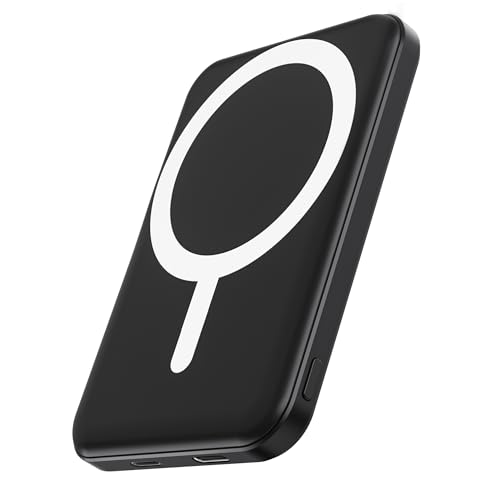
| podoru Magnetic 5000mAh | Snaps to the back of the phone, 15W wireless, pocket-sized | Budget | |
| Anker PowerCore 10K | Slim and light, two-way USB-C, drop-tested build | Budget | |
| Aobbow Magnetic 10000mAh | Magnetic plus built-in cable, five outputs, battery percentage screen | Mid-range | |
| HELLEE 15000mAh | Four cables built in, six outputs, biggest capacity here | Budget | |
How to choose a power bank for an iPhone
Capacity, translated into real charges
Milliamp-hours are printed in huge type on every box, and they are the least useful number there. Conversion losses are real: moving energy from a battery pack into a phone battery wastes some as heat, and wireless transfer wastes more. A 10,000mAh pack does not deliver 10,000mAh to your phone. In practice it is closer to two full charges for a standard iPhone, and noticeably less for a Pro Max. A 5,000mAh magnetic puck is a single top-up, not a day’s supply. A 15,000mAh pack starts to cover a weekend, or one phone plus a tablet and earbuds.
The real question is not “how big can I get” but “what am I actually covering”. A commute and an evening out needs one top-up. A long-haul flight with a dead seat outlet needs two. A camping weekend with no mains power at all is a different purchase entirely.
Magnetic or cable
Magnetic packs snap to the back of a compatible iPhone and charge through the case. Nothing dangles, and you can keep using the phone one-handed while it charges. The trade-offs are fair ones: wireless transfer is slower and warmer than a cable, and the magnets only bite properly on a bare phone or a case built with a magnet ring. A thick non-magnetic case turns a magnetic pack into an awkward brick that slides off in your pocket.
Cable packs are less elegant and more efficient. If your priority is getting from ten percent to something usable before you leave the house, a cable wins every time. Several packs here hedge by offering both.
Watts, and why the input rating matters too
Output wattage decides how fast your phone fills. Anything around 20W is enough to bring a modern iPhone up substantially in half an hour, and higher figures mostly benefit iPads and laptops rather than the phone itself. The number people forget is input: how fast the pack itself refills. A power bank that takes six hours to recharge is one you will forget to prepare, and a flat power bank is just a paperweight with a screen.
Cables: built in, detachable, or your own
Built-in cables mean you can never leave the cable behind, which is genuinely the most common failure mode. The risk is that a frayed built-in cable retires the whole pack. Detachable short cables split the difference: tidy, replaceable, and still attached to the body so they do not vanish into a bag. Loose-cable packs are the cheapest and the easiest to be caught out by.
Ports, and charging more than one thing
Port count sounds like padding until you are the person at the table with a phone at four percent and earbuds that died an hour ago. Two useful outputs is the sensible floor. Beyond that, remember that packs split their output: five devices on a pack rated 20W do not each get 20W, they share. Multi-port packs are for topping up several things slowly, not for charging one thing fast while three others hang off it.
Check the input port too. A pack that recharges over USB-C at a decent rate can be plugged in over dinner and be ready by morning. One that only takes a trickle needs to be plugged in overnight, every time, which is a habit most people do not keep.
Weight, and where the pack actually lives
This is the spec nobody reads and everybody feels. A 5,000mAh magnetic puck at around 120 grams rides on the back of a phone without making it unpleasant to hold. A 15,000mAh pack is roughly three times that and belongs in a bag, not in your hand. Deciding where the pack will live before you buy is more useful than comparing capacity numbers, because a pack that is annoying to carry is a pack you leave at home, and a pack at home has a capacity of zero.
Safety and protection
Every pack here lists protection against overcharging, over-current, overheating, and short circuits, and that is the baseline you should expect rather than a feature worth paying for. What separates them is what happens when something does go wrong. A longer warranty is a real signal: a maker offering three years of cover is making a costlier promise than one offering twelve months. Batteries degrade, and a pack you keep for years will eventually hold less than it did.
Taking it on a plane
Airlines require lithium batteries in carry-on, never checked, and cap capacity by watt-hours rather than milliamp-hours. Everything in this comparison sits comfortably inside the usual allowance, but very large packs, roughly the 20,000mAh-plus territory, start bumping into limits and outright refusals. Some packs are explicitly marked as not permitted on aircraft at all. If you fly often, that alone is a reason to stop scaling up.
INIU 45W 10000mAh Portable Charger
This is the best-selling pack in the group by a wide margin, and the reasoning is easy to follow. It carries a genuine two-charge capacity in a body INIU claims is 40% smaller and 36% lighter than conventional 10,000mAh packs, and it pairs that with 45W output, which is more than an iPhone can use but exactly what an iPad wants. The detail that earns its keep is the short braided USB-C cable that lives attached to the body and unclips when it wears out or when you need a longer one. It is the rare design decision that fixes a real annoyance rather than adding a spec line.
Pros
- Noticeably smaller and lighter than typical 10,000mAh packs
- 45W output has headroom for iPad and small laptops
- Detachable cable is replaceable, so a broken cord does not retire the pack
- Sits well within airline carry-on battery allowances
- Three-year coverage, longer than most in this bracket
Cons
- No magnetic attachment, so it rides in a bag rather than on the phone
- The captive cable is very short by design
Best for: anyone who wants one pack that covers a phone today and a tablet tomorrow, without a brick in the bag.
podoru Magnetic 5000mAh Power Bank
At roughly 120 grams and about half an inch thick, this is the pack you forget you are carrying until you need it. It clings to the back of a compatible iPhone and delivers up to 15W wirelessly, or 20W through the USB-C port if you would rather use a cable. The soft silicone face is a small kindness that keeps the phone’s back unscratched. Capacity is the real limit here: 5,000mAh is one top-up, not a day of freedom, and the second-best-selling position in this group suggests plenty of people decide that is exactly enough.
Pros
- Genuinely pocketable, and light enough to hang off the phone comfortably
- Magnetic attachment means no cable to remember
- Can charge two devices at once, wirelessly and wired
- Slim enough that it does not block the camera
- Lowest price tier in this comparison
Cons
- 5,000mAh is a single partial-to-full charge, no more
- Needs a bare phone or a magnet-ring case to hold properly
- Wireless charging runs warm, as all magnetic packs do
Best for: a day out, a commute, or a night when the phone needs one lift and you refuse to carry a brick.
Anker PowerCore 10K Battery Pack
The unglamorous choice, and a durable one. Anker quotes roughly two iPhone charges from a 8.6-ounce body under two-thirds of an inch thick, with a scratch-resistant shell certified through a drop test. The USB-C port works in both directions, so one cable refills the pack and charges the phone. There is no screen, no magnet, and no built-in cable. What there is instead is a long track record and a build that survives being thrown in a bag every day for years.
Pros
- Among the slimmest 10,000mAh packs available
- Drop-tested, scratch-resistant shell
- Two-way USB-C keeps the cable count down
- Reliable brand support and warranty
Cons
- 5V/3A charging is slower than the 20W-plus packs here
- No battery percentage display, only indicator lights
- You must supply and remember the cable
Best for: someone who wants a dependable pack that disappears into a bag and simply works.
Aobbow Magnetic 10000mAh Power Bank
This one refuses to pick a lane, and that is the point. It magnetically attaches like a puck, carries a built-in cable for anything that will not stick, adds 20W fast charging, and puts a battery percentage on a small screen so you are never guessing. Five outputs mean a phone, earbuds, and a watch can all feed at once. Doubling the podoru’s capacity while keeping the magnetic trick is the trade a lot of people actually want, and it costs you some thickness.
Pros
- Magnetic attachment plus a built-in cable covers both charging styles
- 10,000mAh is roughly two iPhone charges, not one
- Exact battery percentage on the display, no guesswork
- Charges up to five devices at once
- Full protection suite for temperature, current, and short circuits
Cons
- Thicker and heavier on the back of a phone than a 5,000mAh puck
- Magnetic hold still depends on a bare phone or magnet-ring case
Best for: someone who wants magnetic convenience without giving up two-charge capacity.
HELLEE 15000mAh Power Bank with Built-In Cables
Four cables live on this pack: USB-A, USB-C, Lightning, and Micro-USB. Nothing to pack, nothing to lose, and no arguments about whose cable is whose. HELLEE quotes roughly 3.5 iPhone charges from the 15,000mAh cell and around 50% in half an hour from the 22.5W output, and there are six outputs if a whole group needs power at once. The bi-directional USB-C port refills the pack quickly enough to be practical.
Pros
- Highest capacity here, roughly three-plus phone charges
- Four built-in cables cover essentially any device you meet
- Six outputs for charging a group at once
- LED display shows the exact remaining percentage
- Still within airline carry-on battery allowances
Cons
- Bulkier and heavier than the 10,000mAh options
- A damaged built-in cable cannot be swapped out
- No magnetic attachment
Best for: long trips, shared charging, or anyone tired of hunting for the right cable.
The verdict
Best overall: INIU 45W 10000mAh. It is the clear best seller here, and it earns that. Two charges, a body small enough to stop being a decision, 45W that leaves room for an iPad, and a detachable cable that fixes the single most common power bank failure. If you buy one pack without thinking hard about it, this is the one that will not disappoint.
Best value: podoru Magnetic 5000mAh. The lowest price tier in the group, the second-strongest seller, and the only one small enough that you will genuinely always have it. Accept the one-top-up limit and it is hard to argue with.
Best for capacity: HELLEE 15000mAh. When the trip is long or the group is large, three-plus charges and four attached cables beat elegance. It is the pack you bring when running out is not an option.
If you want magnetic convenience but 5,000mAh feels thin, the Aobbow is the middle road. If you just want something proven that lives in a bag and never complains, the Anker still does that job.
Frequently asked questions
How many charges will a 10,000mAh power bank really give an iPhone?
Around two for a standard iPhone, and less for a Pro Max. Energy is lost as heat when moving between batteries, so the printed capacity is never what reaches your phone. Work on any manufacturer’s charge count as an optimistic ceiling rather than a promise.
Can I take a power bank on a plane?
Yes, in your carry-on only. Lithium batteries are not allowed in checked luggage. Airlines cap capacity by watt-hours, and every pack in this comparison sits within the usual allowance. Packs far above this size range are where refusals start.
Do magnetic power banks work with a case on?
Only if the case has a magnet ring built in, or is thin enough not to interfere. A thick plain case will either weaken the hold badly or stop it entirely. Some cases also trap heat, which slows charging further.
Is wireless charging from a magnetic pack worse for the battery?
It is not damaging, but it is less efficient and runs warmer than a cable, and sustained heat is what ages a battery over years. If you are charging from nearly empty and want speed, use the cable. For a casual top-up, the convenience is worth the small cost.
Does a higher wattage rating charge my iPhone faster?
Only up to a point. An iPhone draws what it is designed to draw, so beyond roughly 20W to 30W the extra headroom does nothing for the phone. It matters if you also charge an iPad or a laptop from the same pack.
This article may contain affiliate links; see our Affiliate Disclosure.